If your book pile has outgrown the corner of your desk, a desk bookshelf solves a problem that a flat desktop shelf or a small hutch can’t: it gives you enough vertical height and shelf depth to actually store a book collection, not just a few stray paperbacks. Unlike a desk shelf that sits on your work surface or a desk hutch that stacks storage directly above your keyboard, a desk bookshelf is a standalone, floor-standing unit you place beside or near your desk, sized specifically for books rather than office supplies. After comparing tier count, shelf depth, stability, and material across 8 desk bookshelves currently listed on Amazon, the VASAGLE Ladder Shelf, 4-Tier Bookshelf stands out as the strongest all-around pick, thanks to a leaning ladder frame that tucks neatly into a desk corner, a near-perfect customer rating, and one of the largest review histories in this category.




Top Picks at a Glance
- Best Overall: VASAGLE Ladder Shelf, 4-Tier Bookshelf – a leaning ladder-style steel-frame build backed by a 4.8-star average across more than 11,000 ratings.
- Best Budget: Furinno LUDER Book Shelf, 3-Cube Bookshelf – a simple, compact bookcase with the largest review base in this roundup at a low price point.
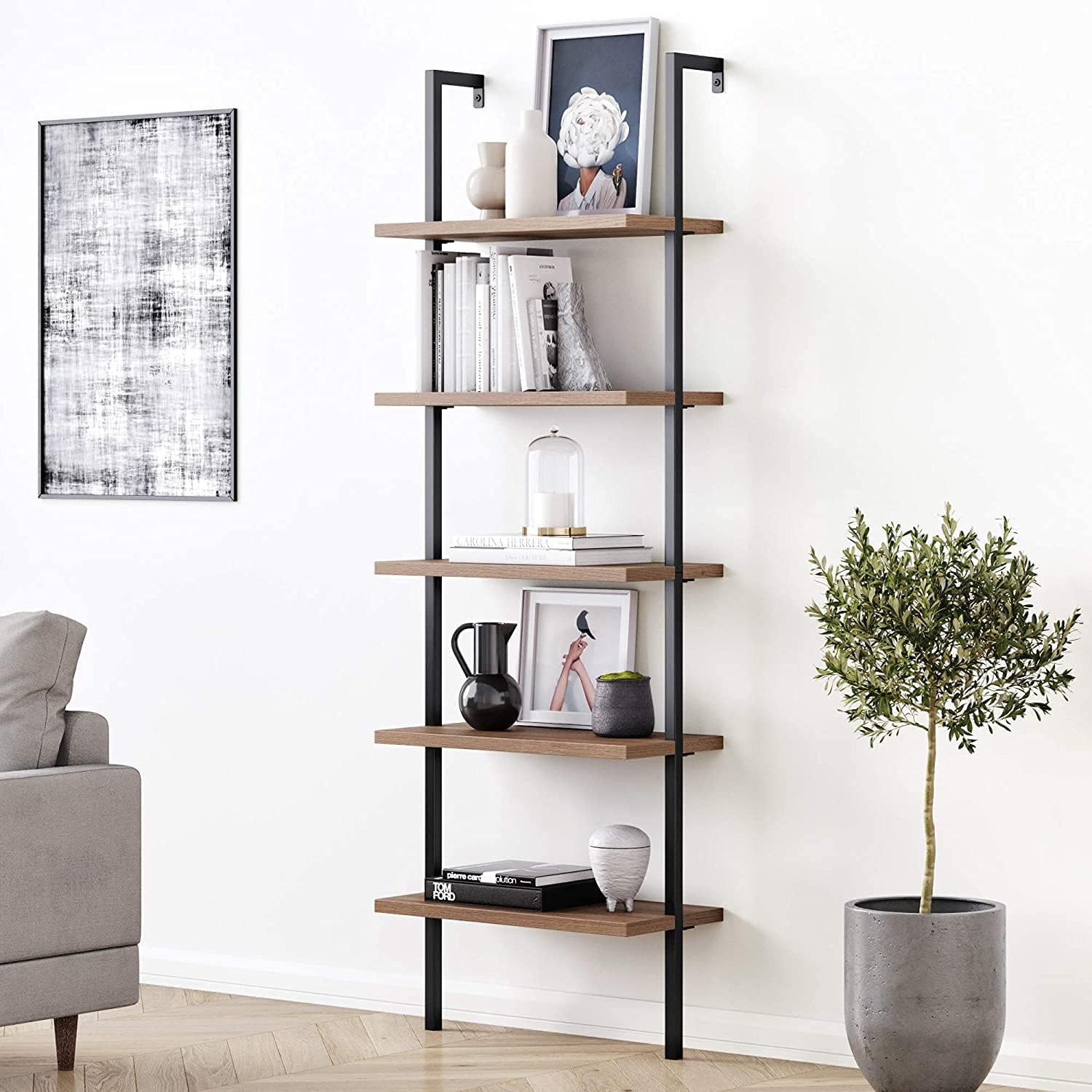
- Best Premium: Nathan James Theo 5-Shelf Oak Wood Modern Bookcase – an open ladder-style bookcase with an oak wood shelf and black metal frame build.
- Best for Maximum Book Capacity: Hzuaneri Bookcase, Tall Narrow 7-Tier – seven shelves stacked into a narrow footprint, the tallest option in this lineup.
- Best Solid Wood: Casual Home 100% Solid Wood 5-Shelf Ladder Bookcase – a genuine solid-wood build standing 72 inches tall for buyers who’d rather skip engineered wood entirely.
- Best for Narrow Spaces: Furinno Fulda Book Shelf, 3-Tier Narrow Bookshelf – a slim, shallow-depth unit built to slide into a tight gap beside a desk.
- Best for Corner Desks: IRONCK Tall Narrow Bookshelf, 8-Tier Corner Bookcase – an eight-tier corner-fit design that pairs naturally with an L-shaped desk.
- Best Compact Industrial Pick: MNEETRUNG Small Bookshelf, 3-Tier Industrial – a small-footprint, metal-and-wood unit carrying the highest customer rating of the group.
What Actually Counts as a Desk Bookshelf
Search for a desk bookshelf on Amazon and you’ll get a mix of three different product types, which is exactly why this category causes so much buyer confusion. Some results are genuine bookcases — tall, vertical, floor-standing units built to hold books. Others are flat desktop organizers that sit directly on your work surface, and a smaller group are desk hutches, which stack mixed storage — books, supplies, decor, sometimes drawers — right above the desk itself.
The kind of unit covered in this guide is a standalone piece that sits on the floor beside or near your desk rather than on top of it, sized specifically for books: shelves deep enough to hold a hardcover without the spine hanging off the edge, and spacing tall enough for a stack of paperbacks or a row of textbooks standing upright. If what you actually want is a small riser to lift a monitor or hold a few files, our desk shelves guide covers that simpler, desktop-only category. And if you want mixed storage that sits right above your keyboard — books plus supplies, sometimes a drawer — our desk hutches guide is the better match. This guide sticks to the taller, book-focused furniture category: real bookcases and ladder shelves meant to live beside a desk, not on top of it.
How Tall Should a Desk Bookshelf Be
Height is the first real decision to make, and it comes down to how many books you’re actually storing today, plus a little room to grow. If you keep a modest stack of paperbacks and a few reference binders near your desk, a compact 3-tier bookcase like the Furinno LUDER Book Shelf or the Furinno Fulda Book Shelf covers that without taking up much visual space. These sit around 27 to 31 inches tall, close to desk height, so they read more like an extension of your workspace than a piece of furniture competing for attention.
Once your collection grows past a single shelf’s worth, a mid-height 4- or 5-tier desk bookshelf, like the VASAGLE Ladder Shelf or the Casual Home Solid Wood Ladder Bookcase, gives you two to three times the capacity while still fitting comfortably beside a desk chair without crowding the walkway. For a serious collection — textbooks, hardcover sets, reference material you’re not willing to store elsewhere — a 7- or 8-tier tall unit such as the Hzuaneri Bookcase or the IRONCK Tall Narrow Bookshelf makes better use of vertical space than adding a second, shorter piece. The trade-off with height is reach: shelves above roughly six feet are hard to use daily without a step stool, so reserve the top tier or two for books you access less often.
Shelf Depth and Spacing for Different Book Sizes
Height gets most of the attention, but shelf depth is just as important for a desk bookshelf that’s actually going to hold books comfortably. A standard paperback needs roughly 6 to 7 inches of depth, a hardcover often needs 8 to 9, and an oversized textbook or art book can run past 10 inches. Several listings in this category state shelf depth around 9 to 12 inches, which comfortably covers paperbacks and most hardcovers, but it’s worth checking the exact number against your largest books rather than assuming any bookcase automatically means deep enough.
Vertical spacing between shelves matters too, especially on ladder-style units where the gap narrows as the frame leans back. A shelf that’s technically wide enough but only 9 or 10 inches tall will fit paperbacks standing upright but not a stack of oversized hardcovers or a three-ring binder. If your collection is a mix of sizes, look for a unit with adjustable shelf spacing, or plan to keep your tallest books on the bottom-most or most open tier rather than forcing them into a shallow upper shelf.
Ladder-Style vs. Traditional vs. Cube Bookcases
Most of the options you’ll come across fall into one of three styles, and each makes a different trade-off between capacity, footprint, and look. A ladder-style or leaning bookcase — like the VASAGLE Ladder Shelf or the Casual Home Solid Wood Ladder Bookcase — has an angled frame that narrows toward the top, giving it a lighter, more open visual profile and a smaller footprint at floor level. The trade-off is that upper shelves are shallower than lower ones, so they suit smaller or lighter items better than a full shelf of hardcovers.
A traditional straight bookcase keeps the same width and depth from top to bottom, which means every shelf holds roughly the same load — useful if your whole collection is similar in size. Tall, narrow versions of this style, such as the Hzuaneri Bookcase or the IRONCK Tall Narrow Bookshelf, pack a lot of shelves into a small footprint, which works well when floor space beside a desk is limited. A cube bookcase, like the Furinno LUDER Book Shelf, is the most compact of the three — a small, modular grid of open cubes suited to a lighter collection, and one that can double as a stand for a small plant or lamp alongside the books. If you’re deciding between styles, match the choice to your actual collection: heavier or larger books do better on a traditional or narrow bookcase, while a lighter, more casual collection is a good fit for a ladder-style or cube desk bookshelf.
Tip-Over Risk and Stability Near a Desk Chair
Any tall, narrow piece of furniture carries some tip-over risk, and a desk bookshelf is no exception — if anything, its usual spot right next to a chair that gets pushed back and rolled around all day makes this more relevant than it would be in a quiet corner of a living room. The general rule is that the taller and narrower a unit is relative to its base, the more careful you need to be about loading and placement.
Before buying, check whether the listing mentions anti-tip hardware or a wall-anchor strap, and plan to use it if the unit is going anywhere near a rolling chair, a walkway, or a home with kids or pets. Loading also matters: keep your heaviest books — hardcovers, textbooks, reference sets — on the lower shelves, and reserve the upper tiers for lighter paperbacks or decor. A wider base relative to height, which you’ll typically find on shorter 3-tier units, is inherently more stable than a tall 7- or 8-tier tower, so if stability is your top concern over sheer capacity, a shorter, wider desk bookshelf is the safer choice.
Material and Weight Capacity
Material has a direct effect on how much weight a shelf can hold over time, which matters more than it seems once you actually load it with books — a single shelf of hardcovers can easily weigh 20 to 30 lbs. Engineered wood (particleboard or MDF with a laminate finish) is the most common and most affordable material, and it handles a normal book collection fine, but thinner engineered-wood shelves can start to sag or bow after months of sustained heavy loading, especially in the middle of a wide shelf.
Solid wood, like the build used on the Casual Home Solid Wood Ladder Bookcase, costs more but resists sagging far better and tends to feel noticeably sturdier in daily use. Metal-frame designs, including several of the ladder-style options in this roundup, distribute weight through a steel frame rather than relying on the shelf material alone, which can make them a good middle ground between price and long-term durability. Whatever material you land on, check the manufacturer’s stated weight capacity per shelf rather than the total product rating, since a desk bookshelf might advertise a high overall capacity while each individual tier is only rated for a modest load.
Footprint and Placement Beside Your Desk
Because this kind of bookcase sits on the floor rather than on your desk, footprint is about the gap next to your workstation, not the desktop itself. Before ordering, measure the width and depth of the space where you plan to put it, accounting for the chair’s full range of motion so you’re not left bumping into it every time you push back from your desk. A narrow desk bookshelf, like the Furinno Fulda Book Shelf, is specifically built for tight gaps where a wider bookcase simply wouldn’t fit.
If your setup includes an L-shaped or corner desk, a corner-fit design like the IRONCK Tall Narrow Bookshelf can tuck into the angle of the desk rather than competing for straight wall space, which is often the most efficient use of a small home office. And if the real issue is that your desk itself is too small to leave any spare floor space at all, it may be worth reconsidering the desk before the bookcase — our small desks guide covers footprint-friendly options sized for tight rooms, which can free up enough space nearby for even a compact desk bookshelf to fit comfortably.
How We Evaluated These Desk Bookshelves
This guide is built from Amazon listing data gathered through Crawlbase rather than in-person testing. For each product, we checked the customer star rating, the number of reviews behind that rating, stated height and shelf depth, tier count, and material description, and we prioritized listings that were genuinely tall, floor-standing bookcases rather than the flat desktop organizers that frequently share similar keywords. Every product name and ASIN in this roundup was cross-checked against current Amazon search results before inclusion. We did not physically assemble or load-test any of these units ourselves — treat the picks above as a shortlist for comparison based on verified listing data, not a guarantee of fit, stability, or capacity for your specific books and desk setup.
Common Mistakes When Buying a Desk Bookshelf
- Buying based on total height alone without checking shelf depth, then finding hardcovers or textbooks don’t fit without hanging over the edge.
- Choosing a tall, narrow unit for a spot near a busy walkway or rolling chair without checking for anti-tip hardware.
- Loading the heaviest books on upper shelves instead of the base, which raises the center of gravity and increases tip risk.
- Confusing a flat desktop organizer with a genuine bookcase because both show up under the same “desk bookshelf” search terms.
- Skipping measurements of the actual floor gap beside the desk, including the chair’s full range of motion.
- Picking a budget engineered-wood unit for a heavy, growing collection instead of a solid wood or metal-reinforced build.
Desk Bookshelf Buying Checklist
- Count your current book collection and add room to grow before picking a tier count.
- Check shelf depth against your largest books, not just the listed tier count.
- Decide between ladder-style, traditional, or cube bookcase based on your collection’s size and weight.
- Look for anti-tip hardware if the unit will sit near a rolling chair or walkway.
- Compare material — engineered wood, solid wood, or metal frame — against how heavy your collection actually is.
- Measure the floor space beside your desk, including your chair’s full range of motion.
- Check the per-shelf weight capacity, not just the total product rating.
- Confirm the listing is a genuine floor-standing bookcase and not a flat desktop organizer.
A well-chosen desk bookshelf pulls double duty: it stores your books and keeps your actual work surface clear. Match height and shelf depth to your collection first, check stability if it’s going near a rolling chair, and the rest of the decision mostly comes down to style, material, and budget.
FAQ
What’s the difference between a desk bookshelf and a desk shelf?
A desk bookshelf is a standalone, floor-standing bookcase sized for real books, with shelves deep and tall enough for paperbacks, hardcovers, and textbooks. A desk shelf is a smaller, shallower riser that sits directly on the desktop itself, meant for lifting a monitor or holding a few everyday items rather than storing a book collection.
How tall should a desk bookshelf be?
It depends on your collection size. A compact 3-tier unit around 27 to 31 inches tall suits a modest stack of books, while a 5- to 8-tier bookcase reaching 5 or 6 feet makes more sense for a larger collection. Keep in mind that shelves above roughly six feet are hard to reach comfortably without a step stool.
Will a tall, narrow desk bookshelf tip over?
It can, especially if it’s positioned near a rolling desk chair or a busy walkway. Look for anti-tip hardware or a wall-anchor strap, keep your heaviest books on the lower shelves, and choose a wider base relative to height if stability matters more to you than maximum capacity.
How deep should the shelves be?
Paperbacks generally need about 6 to 7 inches of shelf depth, hardcovers need closer to 8 or 9 inches, and oversized textbooks or art books can run past 10 inches. Check the stated shelf depth against your largest books rather than assuming any bookcase will fit them.
Is solid wood worth the extra cost over engineered wood?
If you’re storing a heavy or growing book collection, yes — solid wood resists sagging better than engineered wood over time and tends to feel sturdier in daily use. For a lighter collection, a well-built engineered-wood or metal-frame desk bookshelf is usually enough.
Can a desk bookshelf fit next to a small desk?
Often, yes, if you choose a narrow or corner-fit design and measure the available floor space first, including your chair’s full range of motion. If your desk itself leaves very little spare floor space, it may be worth looking at a more compact desk before adding a bookcase nearby.