
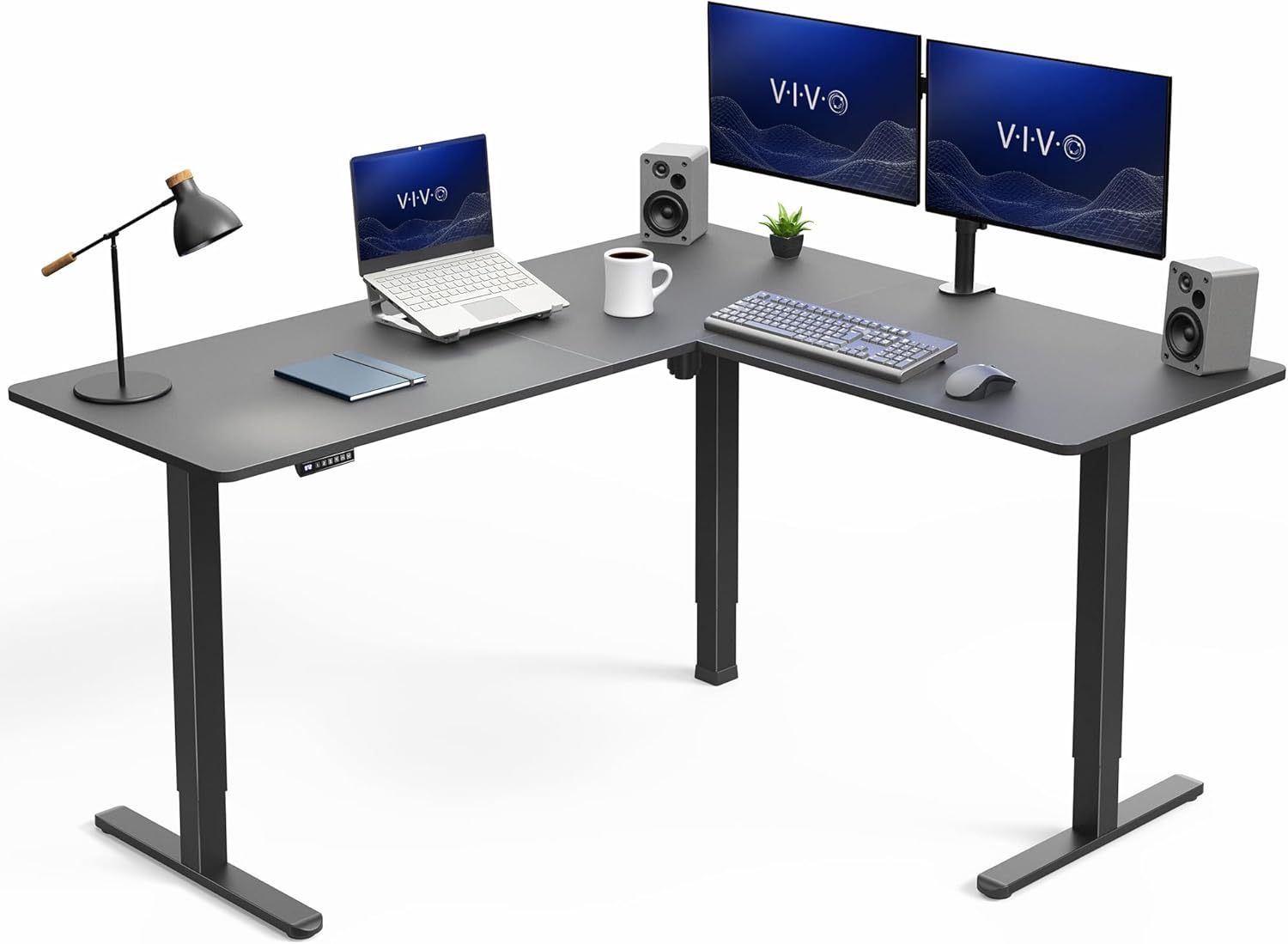
Choosing among the best corner standing desks means balancing two things that don’t always go together: a large L-shaped work surface and a lifting system strong enough to raise that whole surface smoothly. This style of desk gives you far more usable space than a rectangular sit-stand model, but it also demands a sturdier motor setup, a well-built connector board, and a bit more planning for where it will actually fit in your room. Below, we break down what separates a genuinely stable corner standing desk from one that wobbles at the seam, plus how to match a model to your room layout and budget for 2026.


Top Picks at a Glance
- Best Overall: VIVO Black 63 x 55 in Corner Standing Desk, DESK-E3CTB — a reversible L-shaped table with dual-motor lift and a 225 lb capacity that covers most home office setups.
- Best Premium: VIVO Black Electric Corner 3 Leg Standing Desk Frame, DESK-V130EB — a triple-motor frame rated to 300 lbs for anyone running a heavier multi-monitor setup (frame only, tabletop sold separately).
- Best Budget: FEZIBO 63″ x 55″ L-Shaped Standing Desk, White — a lower-cost entry point into an electric L-shaped desk without dropping the splice board build quality.
- Best for Flexible Room Layouts: ErGear 63″ L Shaped Standing Desk, Left & Right Interchangeable Installation — built to be reconfigured for either side of a room.
- Best for Cable & Power Management: HUANUO 63″ L-Shaped Standing Desk with Built-in Power Outlets — an integrated power strip holder keeps cords off the floor.
- Best for Long Work Sessions: Cubiker Reversible L Shaped Standing Desk — a wide, ergonomic layout with memory buttons for repeatable sit-stand transitions.
- Best with Storage: YITAHOME L Shaped Standing Desk with Power Outlets & LED Lights — adds drawers and a sliding door to a farmhouse-style corner frame.
- Best Mid-Range Value: Agilestic 63 x 55 Inch L Shaped Electric Standing Desk — a balanced option with hooks, a splice board, and an approachable price between the budget and premium tiers.
What Makes a Standing Desk “Corner” or “L-Shaped” — And Why It’s Different
A corner standing desk combines two work surfaces joined at roughly a right angle, forming an L that wraps around a room corner instead of running along a single wall. That extra footprint is the whole appeal: you get one wing for a monitor setup and a second wing for writing, a laptop, or side equipment, all height-adjustable together. It’s a meaningfully different product from a few desks that sound similar on a quick search.
A fixed-height corner desk uses the same L-shaped footprint but has no motor at all — the height is set once during assembly and never changes. That’s a fine choice if you never plan to stand while working, but it isn’t a substitute for a corner standing desk if sit-stand movement is the point of buying one. A general adjustable height desk does have a motor or crank, but it’s a straight rectangular top, not an L — it won’t give you the wraparound corner workspace this guide is about. And a compact standing desk is built small on purpose for tight rooms; it isn’t shaped like an L and isn’t meant to replace one. Keeping these three distinctions straight up front will save you from ordering the wrong category entirely.
Motor & Lifting System: Why Dual-Motor Matters for L-Shaped Desks
The lifting mechanism is where this type of desk earns or loses your trust. A rectangular sit-stand desk can sometimes get away with a single motor because the load is short and centered. An L-shaped model can’t — the top is longer, heavier, and asymmetrical, so a single motor has to push weight it wasn’t really designed to move evenly. The practical result on underpowered models is a top that rises unevenly, drifts out of level over time, or stresses the joint where the two wings connect.
That joint is called the splice board (sometimes “connector board”), and it’s the structural seam that turns two separate panels into one continuous L-shaped surface. On a well-built model, the splice board is metal-reinforced and bolts to both wings and the frame, so the whole assembly rises as one unit. On a weaker build, it’s a thin plate that flexes under load, which shows up as wobble right where two monitors and a keyboard tray usually sit. When you’re comparing models, dual-motor lifting paired with a documented splice board is the single strongest signal that a desk will hold up over years of daily raising and lowering rather than months.
Weight Capacity and Load Distribution Across the Full L
Listed weight capacity on a corner standing desk is usually measured for the frame as a whole, not for how that weight is distributed once you’ve spread a dual-monitor arm, a PC tower, a printer, and a desk lamp across two wings instead of one straight top. In practice, weight sitting near the outer corner of the L puts more leverage on the lifting columns than the same weight centered on a rectangular desk, so a model rated at 225 lbs won’t necessarily feel as roomy as that number suggests once you load it realistically.
Before buying, add up what will actually live on the surface: monitors and their mounts, a full-size tower or dock, any storage bins, plus whatever you tend to set down without thinking about it. Then look for a model with at least 25-30% more rated capacity than that total. If you’re running a genuinely heavy setup — multiple large monitors, audio gear, a docking station, and a printer — a triple-motor frame built for higher capacity is worth the extra cost over a standard dual-motor model.
Left/Right Configuration and Room Fit
Because a corner standing desk is asymmetrical, it has to be built (or rebuilt) to match the corner it’s going into — one wing extending left, the other right, meeting the room’s actual corner rather than an imaginary one. Some models ship reversible, meaning you choose the orientation during assembly and can, with effort, flip it later if you rearrange the room. Others are fixed to one configuration out of the box, so it pays to double-check the listing before ordering rather than assuming every L-shaped desk can be mirrored.
Room fit matters just as much as orientation. It occupies noticeably more floor space than a rectangular sit-stand desk of similar width, because both wings extend into the room rather than staying flush against one wall. Before ordering, measure the actual corner, the swing radius your chair needs when it’s pushed back, and any doorway, closet, or vent that the longer wing might block. It’s a step people skip more often with this desk style than with a standard one, precisely because the shape makes the footprint easy to underestimate on paper.
Price Premium: Corner Standing Desks vs Standard Adjustable Desks
Expect to pay noticeably more for a corner standing desk than for a comparably built rectangular sit-stand desk — often 30-70% more depending on the motor count and tabletop size. That premium comes from real material differences: an L-shaped model typically needs three or four legs instead of two, a longer total run of steel frame, a larger tabletop cut from two joined panels, and in many cases a second or third motor to lift it evenly. Added features like built-in power outlets, LED lighting, or storage drawers push the price higher still.
Whether that premium is worth paying comes down to how you’ll use the space. If you genuinely need two working surfaces at standing height — say, a monitor station plus a separate writing or hobby area — it earns its higher price by replacing what would otherwise be two separate desks. If you only need one continuous work surface and don’t have a corner to fill, a standard rectangular adjustable height desk will do the same sit-stand job for less money and less floor space. And if you’re certain you’ll never adjust the height, a fixed corner desk gets you the L-shaped layout without paying for motors you won’t use.
Assembly, Storage Features, and Everyday Usability
Assembly on a corner standing desk generally takes longer than on a rectangular model, simply because there are more legs, more frame sections, and a splice board to align correctly before the top goes on. Most manufacturers estimate one to two hours solo, though having a second person hold the tabletop steady while you secure the splice board makes the process noticeably easier and reduces the chance of misalignment.
Once assembled, day-to-day usability often comes down to smaller features: memory height presets that let you return to your preferred sitting and standing positions with one touch, built-in power outlets or USB ports so cords don’t trail across the floor, and drawers or open shelving that put supplies within reach without eating into the work surface. None of these are strictly necessary, but they’re the details that make the extra footprint feel organized rather than cluttered. If you’re setting one up on hard flooring, pairing it with anti-slip pads under the legs can help keep a heavier frame from creeping during daily height adjustments.
How We Evaluated These Desks
This guide is built from Amazon listing data gathered for the search term “corner standing desk adjustable L shaped,” including each product’s stated motor configuration, weight capacity, dimensions, customer rating, and review count. We prioritized listings with a meaningful number of verified reviews and cross-checked product names directly against the retailer data rather than combining or inventing model details. We have not physically tested these desks in person; this is a research-based buying guide, not a hands-on lab review, and pricing or availability shown on Amazon may shift after publication.
Common Mistakes When Buying a Corner Standing Desk
- Ordering an L-shaped desk without measuring the actual room corner, chair clearance, or nearby doorways first.
- Ignoring left/right configuration and assuming any model can be mirrored to fit either side of a room.
- Choosing a single-motor desk for a heavy multi-monitor setup that really calls for dual or triple motors.
- Confusing a corner standing desk with a fixed-height corner desk or a small-footprint compact standing desk that isn’t shaped like an L at all.
- Overlooking splice board quality and judging the desk only by its listed weight capacity.
- Skipping cable planning until after the desk is already assembled and pushed into place.
Buying Checklist
- Measure the room corner, wing lengths, and chair swing radius before ordering.
- Confirm whether the desk ships reversible or in a fixed left/right orientation.
- Add up your actual equipment weight and add a safety margin above the rated capacity.
- Look for dual-motor (or triple-motor for heavier loads) lifting with a reinforced splice board.
- Decide whether built-in outlets, storage drawers, or LED lighting are worth the added cost.
- Compare the price premium against a standard adjustable height desk to confirm the L-shape is actually needed.
- Plan for a longer, two-person assembly session rather than a quick solo setup.
FAQ
Does a corner standing desk need a dual motor?
For most setups, yes. This style of desk carries a longer, heavier, asymmetrical top than a rectangular sit-stand desk, and a dual-motor lift keeps both wings rising evenly instead of straining the splice board. Single-motor versions exist and can work for lighter loads, but dual-motor is the safer default.
How much weight can a corner standing desk hold?
Most models in this guide are rated between roughly 150 and 300 lbs, though that figure describes the frame’s total capacity rather than how weight is distributed once it’s spread across two wings. Add up your actual equipment and leave a margin rather than buying right at the listed limit.
Can I change the left/right orientation after assembly?
It depends on the model. Some corner standing desks are explicitly reversible and can be reconfigured with some disassembly if you rearrange your room later; others are built for one fixed orientation only. Check the listing before you order rather than assuming every model can be mirrored.
What’s the difference between a corner standing desk and a corner desk?
A corner standing desk has a motor or crank that changes its height, so you can sit or stand throughout the day. A fixed corner desk shares the same L-shaped footprint but has no adjustment mechanism at all — the height is set once and stays that way, which only makes sense if you don’t plan to stand while working.
How is a corner standing desk different from a compact standing desk?
They solve opposite problems. A compact standing desk is built small and narrow on purpose to fit tight rooms, while an L-shaped model wraps around a room corner to maximize usable surface area. If floor space is limited, a compact model is the better fit; if you have a corner to fill and need more workspace, a corner standing desk makes more sense.
Why do corner standing desks cost more than standard adjustable desks?
This style of desk typically needs more legs, a longer frame, a larger two-panel tabletop, and often an extra motor compared to a standard rectangular adjustable desk, which adds up to a real price premium — commonly 30-70% more. Added features like storage drawers, built-in outlets, or LED lighting push the price up further.