A desk that works fine in a spare bedroom usually falls apart in a garage. Dust from the driveway settles into every seam, a dropped wrench can dent a thin laminate top, and a garage that swings from freezing mornings to hot summer afternoons will warp cheap particleboard within a season. If you’re shopping for desks for garages, the real question isn’t which desk looks the nicest — it’s which one can take grease, temperature swings, tool weight, and the occasional splash from a wet car without falling apart.
Quick answer: for most people converting a garage bay into a workshop, hobby corner, or side-hustle workspace, the Eltean 48″ Workbench, Heavy Duty 2500 LBS Capacity Work Benches for Garage is the strongest all-around pick — it pairs a genuinely heavy-duty frame with drawer storage and a pegboard, which covers both “desk for a laptop” and “surface for tools” in one footprint. If you want something lighter and more budget-friendly that still adjusts for sit-stand comfort, the Claiks Electric Height Adjustable Standing Desk is a sensible starting point. And if you need serious capacity for a two-car garage workshop, the Betterhood 96″ 2-in-1 Convertible Adjustable Workbench gives you the most surface area and load rating of the group. Every option below was pulled from real, currently listed Amazon products rather than invented or assumed — see the “How We Evaluated” section for how they were chosen.
This guide focuses specifically on functional durability for garage conditions. If what you actually want is the metal-and-wood look of an industrial desk regardless of where it sits, our best industrial desks guide covers that aesthetic in more depth — this article is about desks for garages that hold up to actual garage use, not just desks that look rugged.



Top Picks at a Glance
- Best Overall: Eltean 48″ Workbench, Heavy Duty 2500 LBS Capacity Work Benches for Garage — drawers, a pegboard, and a work light on a frame rated well above typical laptop-and-tools use.
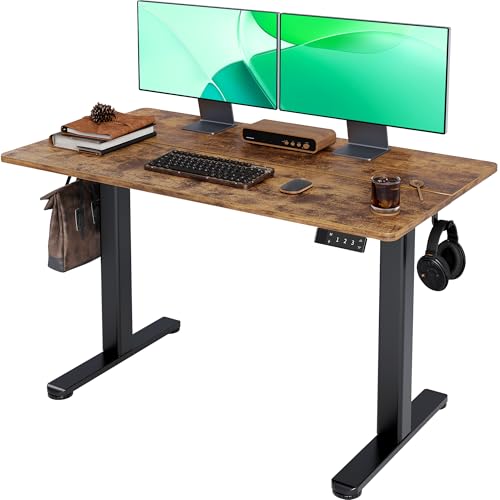
- Best Budget: Claiks Electric Height Adjustable Standing Desk, 48×24 Inch, Rustic Brown — the lowest-cost sit-stand option in this list, better suited to computer work than heavy tool loads.
- Best Premium / Heavy-Duty Capacity: Betterhood 96″ 2-in-1 Convertible Adjustable Workbench, L-Shaped & Extended 5000 LBS Heavy Duty Work Table — the largest footprint and highest load rating of the group.
- Best for Small Garages: WEN WB4723T 48-Inch Workbench with Power Outlets and Light, Black — a compact 48-inch frame that doesn’t eat into a single-car bay.
- Best Adjustable Height: OLBRUS 48″ Adjustable Workbench with Power Outlet and Rubber Pad — multiple height settings for switching between seated laptop work and standing project time.
- Best for Tool Storage: 65″ Heavy Duty Garage Workbench with Storage Drawers & Pegboard — lockable cabinets and a pegboard keep tools organized right at the desk.
- Best for Corner Layouts: 64″ Heavy Duty L-Shaped Workbench with Outlets & Pegboard, Walnut — an L-shaped frame that makes use of an otherwise wasted garage corner.
- Best Mobile / Rolling: Betterhood 70″ Adjustable Workbench on Wheels, 2000 LBS Heavy Duty Work Table — locking casters for reconfiguring a garage bay between parking and project time.
What Actually Makes a Desk Right for a Garage
A desk built for this environment needs to satisfy two jobs that don’t usually overlap: it has to be a stable surface for a laptop, monitor, or paperwork, and it has to survive the same conditions as a workbench. That combination is what separates genuine desks for garages from desks that were simply moved into a garage because there was space. A regular home-office desk is built for a climate-controlled room with a carpeted or hardwood floor, light daily use, and nothing heavier than a laptop and a coffee mug sitting on top of it. None of those assumptions hold in a garage.
Four things matter most when you’re evaluating a desk for a garage: the desktop material’s resistance to oil, grease, and dust; the frame’s ability to handle real weight without flexing; tolerance for temperature swings if the garage isn’t heated or cooled; and how easily the surface wipes clean after a project. A desk that checks all four boxes will still look and function the same way in three years. One that’s missing even one of them tends to show damage — swelling, staining, wobble, or a cracked top — within the first year of regular garage use.
It’s worth being clear about what this guide is not. If you’re after the industrial aesthetic — exposed metal legs, reclaimed-wood-look tops, pipe fittings — regardless of whether the desk ever sees a garage, that’s a styling decision covered in our best industrial desks roundup. Plenty of industrial-style desks are not built for actual garage abuse, and plenty of plain-looking garage desks are far tougher than they appear. This article is about the second category: desks for garages that are chosen for what they can survive, not how they photograph.
Desktop Materials That Hold Up in a Garage
The desktop is where most garage desks fail first. Rubberwood tops, common on the heavier-duty options in this list, resist scuffing and hold up reasonably well to occasional oil or grease contact, especially when the manufacturer applies a sealed or coated finish. Laminate-topped desks are lighter on the wallet but vary a lot in quality — a thin laminate over particleboard will bubble or delaminate if it absorbs moisture from a wet car parked nearby, while a thicker laminate over engineered wood with a proper edge seal tends to hold up much longer.
Metal or steel-topped desks are the most resistant to oil, heat, and scratching, which is why several heavy-duty garage workbenches in this list use them, but they can transfer cold in an unheated garage and may show surface rust over time if moisture sits on them without being wiped away. Plain MDF or unsealed particleboard is the material to be cautious about — it’s common in budget furniture built for indoor home offices, and it swells, sags, or delaminates faster than any other option once it’s exposed to a garage’s humidity and temperature swings. If a listing doesn’t specify the desktop material or finish, treat that as a sign to look elsewhere for something more durable.
Weight Capacity and Frame Construction
These setups need to carry more than a laptop. Between a monitor, a small equipment case, hand tools, or a 3D printer, it’s easy to load a desk well past what a typical office desk was designed for. Most of the heavy-duty workbenches in this guide are rated between 2,000 and 5,000 lbs of static load capacity, which sounds like overkill for a laptop but accounts for real garage use — leaning on the desk, stacking tool boxes, or setting down an engine part temporarily.
Steel frames generally outperform wood frames for rigidity and long-term weight tolerance, particularly on desks with a wider or L-shaped top where flex becomes more noticeable under load. Leveling feet matter more than most buyers expect, since garage floors are rarely as flat as a poured living-room slab; a desk without adjustable feet can rock or wobble even if the frame itself is sturdy. The trade-off with higher-capacity frames is weight and portability — a 5,000-lb-rated workbench is not something you’ll casually move once it’s assembled, while a lighter desk built mainly for computer use will flex more under sustained tool weight.
Hybrid Desk-Workbench Styling for Tinkering and Hobby Use
Many of the strongest desks for garages on Amazon right now are really hybrid workbenches — built with a pegboard along the back, built-in power outlets or USB ports, and sometimes an integrated LED light bar. These features are genuinely useful rather than just marketing add-ons if you’re using the desk for hobby or tinkering work: a pegboard keeps small tools within reach without cluttering the desktop, built-in outlets mean you’re not running an extension cord across the garage floor, and a work light helps in a garage bay that doesn’t get much natural light.
The distinction worth keeping in mind is that a desk for a garage still needs a clean, flat working area for a laptop, paperwork, or assembly work — not just tool storage. A pure workbench, by contrast, is optimized entirely around tool access and durability, with no real thought given to comfortable computer use. If you split time between screen-based work and hands-on projects, look for one that keeps at least two-thirds of the top clear for actual desk work, with storage features built around the edges rather than eating into the main surface.
Height Adjustability: Do You Need It?
Height adjustability matters more in a garage than people expect, mainly because garage projects tend to run long — an afternoon of soldering, assembly, or repair work is easier on your back and shoulders with a sit-stand option than with a fixed-height surface. Electric adjustable desks and workbenches let you switch between a seated laptop session and standing project work without switching furniture.
The trade-off is capacity. Adjustable-height desks and workbenches, including the electric standing desk and the adjustable workbenches in this list, are generally rated for lighter loads than fixed heavy-duty frames, since the lifting mechanism adds a point of potential flex that a solid, fixed frame doesn’t have. If your priority is maximum weight capacity for tools and equipment, a fixed-height option with a steel or reinforced frame is usually the safer choice. If your priority is comfort during long sessions and the load stays closer to laptop-and-hand-tools territory, an adjustable-height desk for the garage is worth the trade-off.
Mobility vs. Stationary Setup
Garages double as parking spaces for most people, which makes mobility a real consideration rather than a nice-to-have. A desk on locking casters can be rolled out of the way when a car needs to pull in and back into position afterward, which matters if your garage isn’t dedicated entirely to workshop use. The trade-off, again, is capacity — rolling garage desks in this list tend to sit toward the lower end of the weight-rating range compared with stationary, bolted-down options, since the caster mounts and wheel hardware add a weaker point in the frame.
If your garage bay is dedicated full-time to a workshop or office setup and doesn’t need to share space with a vehicle, a stationary desk with leveling feet will generally be sturdier and better suited to heavier tool use. If you need the flexibility to clear the space regularly, prioritize one described as having locking (not just swiveling) casters, since locked wheels are what actually keeps the desk from creeping during use.
Sizing a Garage Desk to Your Space
Garage dimensions vary enormously, so measuring before you buy matters more here than it does for a home office. A single-car garage rarely has room for anything wider than about 48 to 60 inches without blocking a walkway or a vehicle door, which is why several of the compact options in this list stay in that range. Two-car garages with a dedicated workshop side can usually accommodate the larger 65-to-96-inch workbenches and L-shaped layouts, especially if the desk sits along a back or side wall rather than in the open floor area.
Corner and L-shaped layouts are worth considering specifically because garages rarely have a clean, uninterrupted wall — water heaters, breaker panels, and storage shelving eat into usable wall space. An L-shaped desk can wrap around a corner that would otherwise sit empty, giving you more usable surface without extending further into the parking area.
How We Evaluated These Garage Desks
Every product in this guide was sourced from real, currently listed Amazon search results for garage desk and garage workbench searches, verified against the live listing data rather than assumed or invented. For each one, we looked at the stated desktop material, frame construction, published weight capacity, size, included features (pegboard, outlets, storage, casters), and whether height adjustment was offered. We prioritized listings with a meaningful number of customer reviews so the picks reflect real usage patterns rather than a handful of early buyers, and we cross-checked every product name and ASIN against the Amazon listing before including it here.
We reviewed 8 desks and garage workbenches for this roundup. This is a listing-data-based buying guide, not a hands-on lab test — we did not physically load-test or install these desks ourselves, so treat the picks above as a well-researched shortlist for comparison rather than a guarantee of how a specific unit will perform in your garage.
Common Mistakes When Buying a Desk for a Garage
- Buying a desk styled to look industrial or rugged without checking the actual desktop material or weight capacity — appearance and durability are not the same thing.
- Ignoring published load capacity and assuming any desk can handle tools, equipment, or leaning weight the way an office desk handles a laptop.
- Choosing a desk with an MDF or unsealed particleboard top for an unheated or uncooled garage, where temperature swings and humidity cause the fastest damage.
- Skipping leveling feet on a desk meant for a garage floor, which is rarely as flat as an indoor room’s floor.
- Picking a mobile, wheeled option for heavy tool use when a stationary, higher-capacity frame would be the sturdier choice.
- Overlooking size and clearance, leaving a desk that blocks a walkway or interferes with a parked vehicle.
Garage Desk Buying Checklist
- Confirm the desktop material (rubberwood, sealed laminate, or steel) and whether it’s rated for oil, grease, and moisture resistance.
- Check the published weight capacity against your actual planned use — tools, equipment, or just a laptop and monitor.
- Look for a steel or reinforced frame with leveling feet if your garage floor isn’t perfectly flat.
- Measure your garage space, including vehicle clearance, before choosing a width or an L-shaped layout.
- Decide whether height adjustability matters more to you than maximum load capacity — they’re usually a trade-off, not both at once.
- Check for genuinely useful features — pegboard, built-in outlets, drawers — rather than paying extra for storage you won’t use.
- Decide between locking casters for mobility and a stationary setup for maximum stability.
- Pair a rolling desk with a compatible utility cart if you need extra mobile storage alongside it, or look at desk casters if you want to add mobility to a desk that didn’t come with wheels.
If garage-specific weight capacity isn’t your main concern and you’re really just looking for a sit-stand desk that happens to live in a garage — say, for a home gym office corner or a light hobby space — our best adjustable height desks guide covers that broader category in more depth.
Frequently Asked Questions
Can I use a regular desk in my garage?
You can, but a desk built for an indoor home office often struggles with garage conditions — temperature swings, dust, and the extra weight of tools or equipment. A desk for a garage typically uses a more moisture- and oil-resistant desktop material and a sturdier frame than a standard home-office desk, which is why the options in this guide are built or marketed specifically for garage use.
What’s the difference between a garage desk and a workbench?
It keeps a clear, flat surface for a laptop, paperwork, or light assembly work, while a pure workbench is built entirely around tool access and heavy-duty durability. Several products in this guide are hybrids — heavy-duty workbenches with enough clear desktop space to double as a garage desk for computer use.
Do garage desks need to be height-adjustable?
Not necessarily, but it helps if you spend long stretches of time at the desk switching between sitting and standing. Fixed-height garage desks and workbenches generally offer higher weight capacity than adjustable-height versions, so it comes down to whether comfort or maximum load capacity matters more for your projects.
How much weight should a garage desk hold?
It depends on what you’re putting on it. A desk used mainly for a laptop and light hand tools can get by with a few hundred pounds of capacity, but if you’re setting equipment, tool boxes, or engine parts on it, look for a garage desk or workbench rated in the 2,000-lb range or higher, which is common among the heavier-duty picks in this list.
Will a wood-top desk warp or swell in an unheated garage?
It can, if the wood isn’t properly sealed or the garage sees significant humidity and temperature swings. Rubberwood tops with a sealed finish tend to hold up better than raw MDF or particleboard, but no wood top is entirely immune to a genuinely damp or extreme-temperature garage over the long run.
Do I need casters on a garage desk?
Only if you need to move the desk regularly — for example, to clear space for a parked vehicle or to reconfigure a shared garage bay. If the desk has a dedicated, permanent spot, a stationary frame with leveling feet is usually the more stable and higher-capacity choice.
Choosing between these desks for garages ultimately comes down to matching the desk’s material, frame, and capacity to how your garage actually gets used — as a light workspace, a heavy-duty workshop, or something in between. Use the checklist above, compare current availability and specs on Amazon, and pick the garage desk built for the way you actually work rather than the one that simply looks the part.