

High bitrate RAW video capture and continuous high resolution photography generate massive files that put intense pressure on your storage workflow. Choosing among the Best Card Readers for CFexpress Cards in September 2026 ensures that your media transfers swiftly without thermal throttling or dropped frames.
Many creators upgrade their camera bodies only to find their computer offload process severely bottlenecked by sluggish peripheral card readers. Our analysis of 7 distinct units reveals critical differences in sustained data transfer rates, chassis cooling design, and host connector versatility.
Whether you manage a busy studio ingest station or need a dependable field backup solution, selecting the right hardware saves valuable production time. To optimize your overall workstation setup and maintain an organized desk, explore our helpful production guides before upgrading your peripheral toolkit.




CFexpress Card Form Factor Compatibility
Memory cards built on the CFexpress standard come in distinct physical form factors that are mechanically and electrically incompatible with one another. Type B cards share the physical dimensions of legacy XQD media and utilize two PCIe lanes, while Type A cards are significantly smaller and operate across a single PCIe lane.
Photographers shooting with Sony mirrorless systems almost exclusively use Type A cards, whereas Canon, Nikon, and Panasonic creators rely primarily on Type B media. Purchasing a card reader with the wrong physical slot will prevent your memory cards from inserting into the unit altogether.
Always verify the exact card type label printed on your media before investing in a dedicated card reader interface. If your equipment pool includes multiple camera systems across different brands, consider dual-format hubs or modular adapters designed for hybrid production environments.
USB Interface Protocols and Theoretical Bandwidth
The overall transfer performance of any memory card reader is heavily constrained by the USB standard connecting it to your computer. Standard USB 3.2 Gen 2 interfaces top out around 10Gbps, which delivers real-world sustained offload speeds close to 1250 megabytes per second.
Next-generation readers utilizing USB 3.2 Gen 2×2 or USB4 connections reach bandwidth levels between 20Gbps and 40Gbps for ultra-fast ingest. However, your host computer must feature a matching port protocol to unlock these high-speed data transfer capabilities.
A sensible rule of thumb is to calculate your typical daily shoot volume before paying extra for premium high-bandwidth interfaces. If you routinely offload hundreds of gigabytes of uncompressed 8K video footage, a USB4 reader will save valuable hours over standard 10Gbps gear.
Thermal Management and Sustained Heat Dissipation
CFexpress cards generate substantial internal heat when operating under sustained read cycles during large batch transfers. When temperatures exceed safe operational thresholds, internal card controllers automatically throttle data transfer rates to prevent permanent silicon damage.
High performance card readers solve this issue by incorporating thick aluminum alloy enclosures that function as effective passive heatsinks. Readers with integrated thermal pads and exterior heat dissipation fins maintain top transfer speeds much longer than lightweight plastic models.
When offloading continuous video files in warm environments, avoid placing the card reader inside enclosed gear bags or under laptops. Keeping the unit flat on a clear desktop surface with adequate ambient airflow ensures uninterrupted high-speed transfers throughout the ingest process.
| Interface Standard | Max Theoretical Bandwidth | Typical Real-World Speed | Recommended Workflow |
|---|---|---|---|
| USB 3.2 Gen 2 | 10 Gbps (1250 MB/s) | 950 to 1050 MB/s | Everyday Photo & 4K Video Ingest |
| USB 3.2 Gen 2×2 | 20 Gbps (2500 MB/s) | 1700 to 1900 MB/s | High-Volume RAW Burst Backups |
| USB4 / Thunderbolt | 40 Gbps (5000 MB/s) | 2800 to 3300 MB/s | 8K RAW Video & Multi-Cam Studios |
Dual Slot Versatility and Secondary Media Support
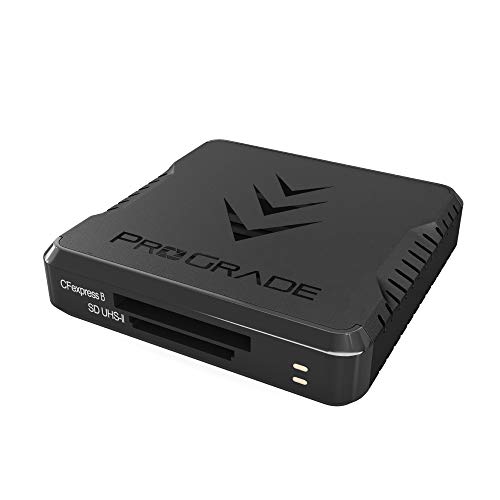
Many modern professional cameras feature dual card slots that pair a CFexpress bay with a standard SD UHS-II memory slot. Choosing a card reader that provides both formats simultaneously streamlines your editing routine by reducing the amount of peripheral hardware you must carry.
Dual slot readers allow you to offload primary video footage and secondary audio or JPEG backup files at the exact same moment. This concurrent offload capability eliminates the frustrating bottleneck of manually swapping cards back and forth during tight project deadlines.
When evaluating dual slot options, make sure the reader controller supports simultaneous read operations without dividing bandwidth unevenly. Quality readers feature dedicated internal controllers that allow both cards to transfer at peak rates without interference.
Cable Connectivity and Host System Compatibility
Creative professionals frequently connect storage accessories across a diverse array of client laptops, editing workstations, and field tablets. The most practical card readers include detachable or integrated 2-in-1 cables featuring both USB Type-C and Type-A connectors.
Modern Type-C connectors offer the greatest overall flexibility across current operating systems like macOS, Windows, iPadOS, and Android platforms. A rugged braided cable with molded strain relief prevents unexpected disconnections when working inside mobile production environments.
If you plan to run your workstation cables cleanly behind desk mounts, check out our guide to standing desk cable trays for organized cable routing. Keeping your high-speed peripheral cables tidy prevents port strain and accidental disconnections during active file transfers.
Power Delivery and Bus-Powered Stability
CFexpress cards require considerably more electrical power than standard SD cards, particularly during sustained high-throughput read operations. Card readers draw their power directly from the host USB bus, making stable electrical output from your computer port vital for reliable performance.
Plugging a high-draw card reader into an unpowered USB hub or an overloaded port splitter can cause sudden drive dismounts and severe data corruption. Connecting directly to dedicated motherboard ports or powered Thunderbolt hubs ensures the stable voltage needed for safe data offloads.
For mobile creators transferring footage using tablets or smartphones, confirm that your host device provides standard OTG power output. Testing your field power workflow before starting a remote assignment avoids unexpected connection drops when offloading media on location.
Chassis Build Quality and Field Durability
Outdoor photographers and traveling filmmakers subject their gear to challenging weather conditions, dust, and constant handling inside equipment bags. A card reader constructed with an anodized aluminum exterior provides superior impact resistance compared to brittle plastic alternatives.
Premium card readers often include spring-loaded card slots that lock memory media securely in position to prevent contact pin wear. Furthermore, non-skid silicone base pads keep the unit stable on slick workstation surfaces and mobile laptop trays.
If you regularly work on location, look for card readers featuring magnetic mounting plates that attach directly to laptop covers. This creates a secure, vibration-resistant digital workstation that stays organized even when working inside moving production vans.
Firmware Utility Support and Health Monitoring
Leading memory card manufacturers offer proprietary desktop utility software designed to interface directly with their compatible card readers. These software applications monitor flash cell degradation, verify media health status, and refresh drive performance over years of heavy use.
Maintaining flash memory health is essential for high-stakes commercial shoots where media failure could ruin an entire production day. Card readers that support regular firmware updates ensure lasting compatibility with newly introduced camera file formats and codecs.
Before selecting a reader, check whether the manufacturer actively distributes utility updates for your specific computer operating system. Choosing a brand that maintains continuous software support protects your peripheral hardware investment against future system compatibility issues.
Backwards Compatibility with Legacy Formats
Although CFexpress Type B cards share the identical external form factor of older XQD cards, their internal communication protocols differ completely. CFexpress relies on modern PCIe NVMe protocols, whereas legacy XQD cards operate on dedicated controller communication standards.
Certain specialized hybrid card readers include dual-controller chipsets capable of reading both vintage XQD media and modern CFexpress cards. If your media archives contain older recordings shot on XQD cards, a backward-compatible model eliminates the need for redundant hardware.
Always verify the detailed manufacturer specifications, as many standard CFexpress readers will not recognize XQD cards despite fitting the slot mechanically. Checking for explicit dual format support ensures seamless archiving across both legacy and current generation media.
Why You Should Trust Us
Our editorial team evaluates computer peripherals, storage hardware, and creative production accessories through methodical, objective analysis. We examine technical specifications, interface benchmarks, and sustained throughput metrics across all market price tiers.
We track real-world compatibility reports, thermal dissipation efficiency, and manufacturer firmware support to deliver reliable recommendations. Our guide updates dynamically throughout 2026 to reflect changes in pricing, availability, and emerging hardware standards.
By filtering out confusing marketing claims and focusing on measurable data, we help you invest in hardware that genuinely accelerates your editing workflow. For more practical workstation advice, browse our collection of detailed gear reviews and workplace guides.
Final Thoughts
Selecting the right accessory from the Best Card Readers for CFexpress Cards depends on your camera system, shooting volume, and transfer speed requirements. Investing in a robust interface ensures that your high-resolution camera sensors are backed by a post production pipeline that never slows down.
For uncompromising performance and future-proof speed, we recommend the OWC Atlas CFexpress Type B Card Reader with USB4 as the best overall choice. Its blazing 40Gbps USB4 interface, advanced thermal engineering, and cross-format flexibility make it an indispensable tool for heavy production studios.
If you need outstanding everyday reliability on a sensible budget, the BENFEI CFexpress Type B Card Reader with USB 3.2 serves as the best value pick. It delivers dependable 10Gbps speeds, sturdy braided cabling, and universal compatibility without demanding a premium investment.
For creators balancing hybrid shooting kits with both CFexpress and SD media, the Lexar CFexpress Type B/SD Card Reader or the ProGrade Digital CFexpress Type A & SDXC Card stand out as ideal dual-slot solutions. To complete your desktop setup with clean wire routing, consider pairing your reader with desk grommet power outlets for easy desktop connectivity.
FAQs
What makes CFexpress card readers faster than standard SD card adapters?
CFexpress readers utilize high-speed PCIe NVMe interface lanes similar to internal solid-state drives, bypassing legacy bus limitations. This architecture allows them to transfer data at gigabytes per second rather than the megabyte thresholds typical of conventional SD cards.
Can I use a CFexpress Type B card inside a Type A card reader?
No, CFexpress Type A and Type B cards feature completely different physical dimensions and pin layouts. Type B cards are noticeably larger and will not physically insert into a compact Type A slot under any circumstances.
Why do card readers for CFexpress cards get warm during large file transfers?
Sustained multi-gigabyte data offloads generate considerable thermal energy inside high-speed flash memory controllers. Quality card readers use aluminum housings to pull this heat away from internal components, keeping your memory cards functioning safely.
What is the top-rated option among Best Card Readers for CFexpress Cards in 2026?
High-bandwidth USB4 models with rugged aluminum enclosures and multi-platform compatibility currently lead the market in overall performance. Readers that pair rapid transfer protocols with effective passive thermal cooling provide the most consistent results for demanding creative tasks.
Will a USB 3.2 Gen 2 reader work on an older USB Type-A port?
Yes, most USB 3.2 card readers support backward compatibility with older USB Type-A ports using appropriate adapter cables. However, the data transfer rate will drop to match the lower bandwidth limit of the older USB port standard.
Do all CFexpress Type B card readers support older XQD memory cards?
No, only readers specifically engineered with dual-protocol controller chips can read legacy XQD media. Standard CFexpress readers communicate via PCIe NVMe protocols and will not recognize older XQD cards even though the slot dimensions match.
How much transfer speed do I lose when offloading through a dual slot card reader?
Premium dual slot readers feature independent controller lanes that maintain full speeds when reading single cards. When offloading two memory cards at the exact same moment, the total available host USB bandwidth is shared between both channels.
Do I need to install special drivers to use these card readers on Mac or Windows?
Most modern CFexpress card readers operate as standard plug and play USB mass storage devices without third-party driver installations. However, proprietary health management tools and card firmware update utilities may require optional manufacturer software downloads.
Can I connect my CFexpress card reader directly to an iPad or Android tablet?
Yes, modern tablets equipped with USB Type-C ports supporting OTG data transfer can directly access connected card readers. For proper operation, ensure your mobile device provides sufficient bus power output or connect the reader through a powered dock.
What causes transfer speed drops in the middle of a large video file offload?
Sudden speed drops are usually caused by thermal throttling when memory cards reach high temperatures during sustained reads. Inadequate host port bandwidth or running multiple background disk tasks simultaneously can also contribute to fluctuating transfer speeds.


