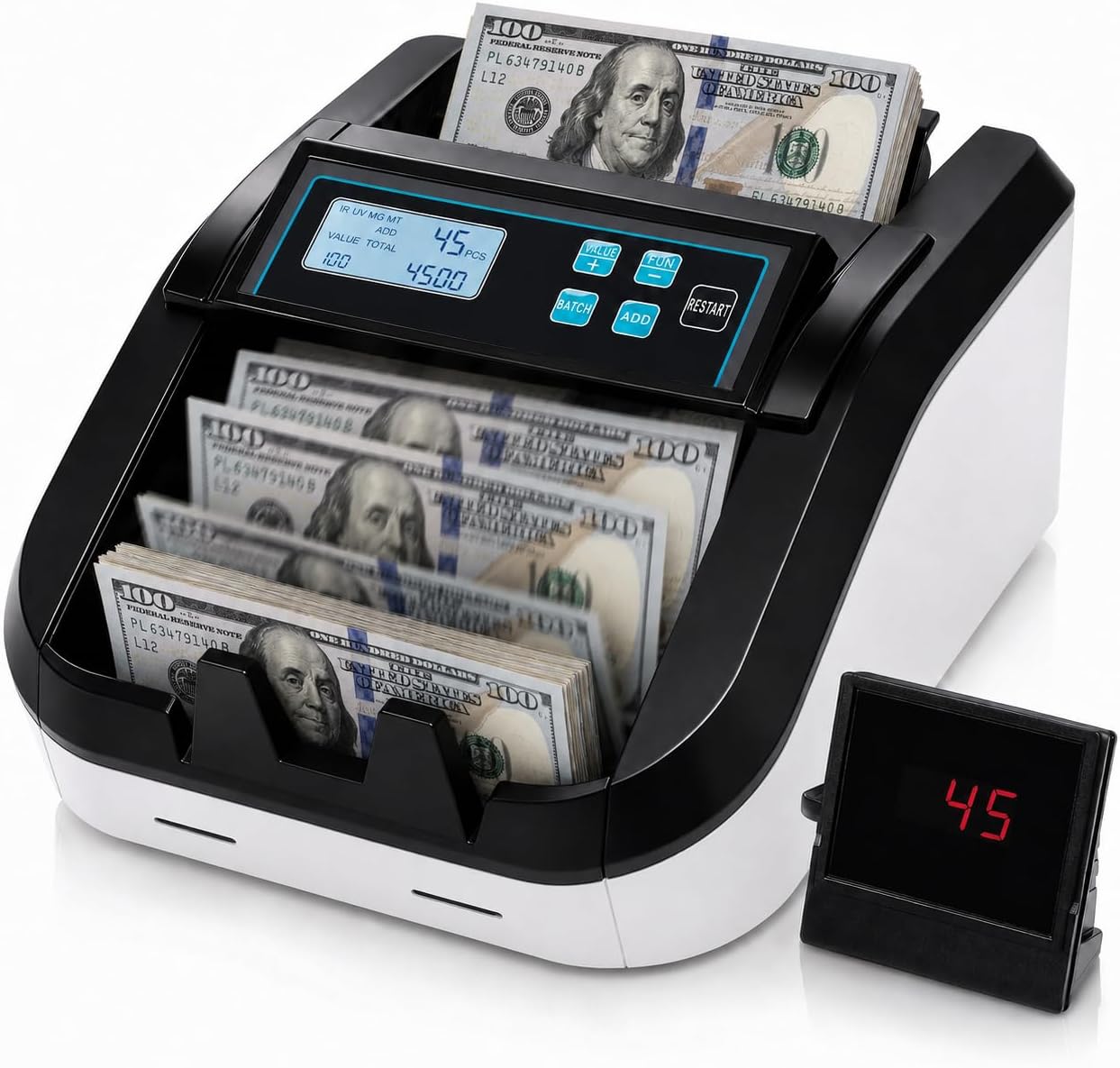
A bill counter is the machine that takes a stack of loose currency and turns it into an exact number in a few seconds instead of several minutes of hand-counting. For any business that handles cash daily — a retail counter, a restaurant closing out registers, a small office reconciling a petty cash drawer — a reliable unit removes both the time cost and the human error that comes from counting the same stack twice because the first total looked wrong. Below we break down what actually separates a dependable machine from one that jams, miscounts worn bills, or can’t keep up once volume picks up, based on real listings pulled from Amazon.
If you only have a minute, here’s the short version: match counting speed to your actual daily volume, don’t settle for a single counterfeit detection method when UV, magnetic, and infrared combined catch far more, decide upfront whether you need mixed-denomination value counting or just single-denomination piece counts, and check the hopper capacity so you’re not reloading every thirty seconds. The pick below checks all of those boxes for most small businesses.



Top Picks at a Glance
- Best Overall: Cassida 5520 UV/MG Money Counter — a business-trusted bill counter with ValuCount, UV/MG/IR detection, and a fast 1,300 notes-per-minute rating.
- Best Budget: H-308 Bill Counter Money Counter Machine — an affordable entry-level pick with batch mode and UV/MG/IR detection for USD.
- Best Premium / Business Grade: Cassida 6600 UV/MG Business Grade Money Counter — a top-loading machine built for daily commercial use, rated at 1,400 notes per minute.
- Best for Mixed Denominations: Aneken N60 Mixed Denomination Money Counter Machine — value counting across multiple denominations with a 3.5″ display and printer support.
- Best with Touch Screen Display: Aneken Mixed Denomination Money Counter with Touch Screen — touch controls paired with mixed and value counting for faster daily setup.
- Best Compact Countertop Pick: ZZap Bill Value Counter & Counterfeit Detector (NC20i) — a smaller-footprint model that pairs value counting with built-in counterfeit checks.
- Best for High-Volume Commercial Use: CARNATION Money Counter Machine — a portable, mixed-denomination unit rated up to 1,200 notes per minute for busy counters.
- Best for Small Business & Office: Aneken Money Counter with Value Count — a compact, budget-friendly bill counter with count, add, batch, auto, and manual modes.
What a Bill Counter Actually Does
This kind of machine feeds currency through internal rollers one note at a time, tallying either the number of notes or their total value while checking each one against built-in counterfeit sensors. That’s a different job from a handheld counterfeit detector pen, which only tests a single bill for authenticity and does nothing to speed up counting a stack. It’s also a different job from a simple cash box, which just stores and organizes cash physically — a cash box doesn’t count anything at all, it just keeps drawers, envelopes, or deposit bags secure and separated.
In a typical business day, a bill counter earns its place during till reconciliation, end-of-shift counts, and cash deposit prep. Instead of a manager flipping through a stack by hand and hoping the number matches the register tape, this equipment delivers a repeatable, machine-verified total in seconds. That consistency matters more than speed alone: two employees hand-counting the same drawer can land on two different totals, but a properly calibrated unit gives the same result every time.
Counting Speed: How Many Bills Per Minute Do You Actually Need
Every bill counter lists a notes-per-minute (NPM) rating, and this is the single spec people fixate on most — often more than they need to. Entry-level and mid-range machines typically run 1,000 to 1,300 notes per minute, which is more than enough for a single-register retail shop, a food truck, or a small office counting a petty cash drawer once a day. Business-grade models push closer to 1,400 notes per minute or higher, which matters more for busy multi-register retail operations, small banks, or cash-heavy businesses like laundromats and vending route operators that count thousands of bills daily.
The practical takeaway: don’t pay a premium for top-tier speed if your actual daily volume is a few hundred bills. A machine rated at 1,000-1,300 notes per minute will finish that job in well under a minute either way. Speed becomes a real differentiator only once you’re regularly counting stacks in the thousands.
Counterfeit Detection Methods: UV, Magnetic, and Infrared Explained
Most bill counters advertise some combination of UV, MG, and IR detection, and understanding what each one actually checks helps you judge whether a listing’s claims are meaningful. UV (ultraviolet) detection shines a UV light on the note and looks for the fluorescent security fibers and strips that only appear under that light on genuine currency. MG (magnetic) detection reads the magnetic ink used in specific areas of real bills, ink that’s difficult to replicate with standard printing. IR (infrared) detection looks for hidden patterns and printing that are invisible in normal light but show up clearly under infrared, which is one of the harder security features to fake.
A machine that combines all three methods gives you meaningfully more coverage than one that relies on a single check, since counterfeiters who manage to fool a UV scan may not replicate magnetic ink or infrared patterns. Some higher-end models add MT (thickness/size) or DD (double-note/half-note detection) sensors on top of UV/MG/IR, catching notes that are stuck together or physically inconsistent in size. That said, no counterfeit detector — regardless of how many detection methods it lists — should be treated as a guaranteed, foolproof authentication system. It’s a strong first line of defense that flags suspicious notes for a closer manual check, not a final legal verdict on authenticity.
Mixed-Denomination vs. Single-Denomination Counting
This is one of the biggest functional differences between bill counter models, and it’s easy to overlook until you’re actually using one. A single-denomination machine counts notes of one value at a time — you load a stack of $20s, it tells you how many $20s and what they total, then you switch to $10s and repeat. A mixed-denomination unit, often marketed with “value count” in the name, automatically identifies each note’s denomination as it passes through and adds up the combined total across all values in a single pass, no pre-sorting required.
Mixed-denomination counting saves real time for businesses that receive cash in varied denominations throughout the day — restaurants, retail stores, and anywhere tips or change come back in a random mix. The trade-off is price: a machine with reliable mixed-denomination value counting generally costs more than a comparable single-denomination model, since it needs more advanced image and value recognition to tell bills apart accurately. If your cash flow is already sorted by denomination before it reaches the counter — say, a bank-adjacent operation — a single-denomination model can be the more cost-effective choice.
Display, Batch Counting, and Add Modes
The LCD or touch display on this kind of machine isn’t just cosmetic — it’s where you read the running count, switch modes, and catch errors before they turn into a mismatched deposit. Batch mode lets you set a fixed target number (say, 100 bills) and the machine stops automatically once it hits that count, which is useful for pre-bundling cash for deposit bags or till setups. Add mode does the opposite: it keeps a running total across multiple separate counting passes, so you can count several partial stacks and let the machine accumulate the grand total for you.
Most models also offer Auto and Manual start options, letting the rollers begin feeding as soon as bills are loaded or only after you press start. None of these modes is universally “better” — batch mode suits businesses prepping standardized deposit amounts, while add mode fits operations counting cash from multiple sources, such as several registers, into one combined total on a single machine.
Hopper Capacity and Feed Reliability
Hopper capacity refers to how many notes the input tray can hold at once, and it directly affects how often you’re stopping to reload mid-count. Compact and budget bill counters often top out around 100-200 notes per load, while business-grade models can handle larger stacks before needing a refill. For high-volume counting, a larger hopper means fewer interruptions and a faster overall process, even if the notes-per-minute rating is similar between two machines.
Feed reliability matters just as much as raw capacity. A machine that frequently jams on worn, folded, or slightly damp notes will cost you more time in troubleshooting than it saves in counting speed. Listings that specifically mention jam-resistant or “jam-free” rollers are worth a second look, especially if your business handles a lot of older, well-circulated cash rather than crisp new bills.
Matching a Bill Counter to Your Business
Not every business needs the same setup. A single-register coffee shop or small retail store is usually well served by a compact, budget-friendly model with basic UV/MG/IR detection and single-denomination counting — the daily volume simply doesn’t justify a business-grade machine. A restaurant or multi-register retail operation handling varied cash and tips throughout the day tends to benefit more from a mixed-denomination unit, since it eliminates the pre-sorting step entirely.
Businesses processing large daily cash volumes — laundromats, vending operators, small check-cashing counters, or offices consolidating deposits from multiple locations — usually get the most value from a business-grade machine with higher notes-per-minute speed, a bigger hopper, and more robust counterfeit detection. If your operation is smaller and cash handling is occasional rather than constant, a mid-range bill counter with solid detection features is typically the more sensible investment than paying for speed you won’t use.
How We Evaluated These Bill Counters
Each pick in this guide for 2026 was selected from active Amazon listings, using published specifications, customer rating, and review volume as the primary signals. We prioritized listings that clearly state a notes-per-minute counting speed, name specific counterfeit detection methods (UV, MG, IR, and beyond) rather than a vague “counterfeit detection” claim, and specify whether the machine supports mixed-denomination value counting or single-denomination piece counting. We also weighed hopper capacity, display type, and price against typical small-business cash volumes, so this guide covers 8 options spanning budget to business-grade tiers rather than a single price point.
Common Mistakes When Buying a Bill Counter
- Overpaying for speed you won’t use. A machine rated for 1,400 notes per minute doesn’t help much if you’re only counting a few hundred bills a day.
- Assuming any UV light means solid counterfeit protection. A unit with only UV detection catches less than one combining UV, magnetic, and infrared checks.
- Buying single-denomination when you need mixed. If your cash mix varies constantly, a single-denomination model forces manual pre-sorting every time.
- Ignoring hopper capacity. A small hopper on a high-volume machine means constant reloading, which erodes the speed advantage.
- Expecting any bill counter to replace manual verification entirely. Detection sensors flag suspicious notes; they don’t issue a final legal ruling on authenticity.
Buying Checklist Before You Choose a Bill Counter
- Notes-per-minute speed matches your actual daily cash volume, not just the highest number available.
- Counterfeit detection combines at least UV, magnetic, and infrared rather than a single method.
- Mixed-denomination value counting is included if your cash mix varies, or single-denomination is fine if it’s already sorted.
- Batch and add modes fit how you actually reconcile deposits or till totals.
- Hopper capacity is large enough to avoid constant reloading during busy periods.
- Listing mentions jam-resistant feeding, especially if you handle older or worn currency often.
- Noise level and footprint work for where the machine will actually sit — a front counter versus a back office.
A bill counter usually isn’t the only piece of cash-handling equipment a business needs. Once counted, cash still has to be stored securely before a deposit run, which is where a good home or business safe comes in as a natural complement rather than a substitute. Offices that also process paperwork alongside cash reconciliation often pair their setup with a reliable paper shredder for sensitive documents, and a sturdy filing cabinet for keeping deposit slips and counting logs organized. Businesses that also handle a lot of loose change may eventually look at a separate coin sorter, and those storing cash drawers between shifts sometimes add a simple lockable cash box — both solve different problems, since neither one counts currency the way this equipment does, but they round out a complete cash-handling setup.
Frequently Asked Questions
Are bill counters accurate for detecting counterfeit money?
A machine with UV, magnetic, and infrared detection catches many common counterfeit indicators, but it’s a strong screening tool rather than a guaranteed, foolproof verification system. Suspicious notes flagged during counting should still get a manual check.
What’s the difference between value counting and piece counting?
Piece counting simply tallies the number of notes in a stack, regardless of denomination. Value counting, found on mixed-denomination models, identifies each note’s denomination and adds up the total dollar value automatically, even across multiple denominations in one pass.
Do I need UV, magnetic, and infrared detection, or is one enough?
A single detection method catches less than a combination does. A model with UV, MG, and IR together offers meaningfully broader coverage than one that only checks a single method, since counterfeits that pass one test may fail another.
Can a bill counter handle mixed denominations automatically?
Only machines specifically built for mixed-denomination or “value count” functionality can do this. Standard single-denomination units require you to sort bills by denomination before loading each stack separately.
How loud are bill counters, and does that matter for a retail counter?
Most models produce a steady mechanical hum while running, comparable to a small printer or fan. It’s rarely disruptive, but if the machine will sit at a customer-facing counter rather than a back office, it’s worth checking reviews for noise complaints on that specific listing.
Do bill counters need calibration or regular maintenance?
Most units are largely maintenance-free for typical use, though keeping the rollers and sensors free of dust and debris helps prevent miscounts and jams over time. Heavy daily use in a high-volume business benefits from periodically checking the manufacturer’s cleaning guidance.