
Summer heat can quickly turn indoor living areas and home offices into stifling environments. Finding the Best Evaporative Coolers for Home provides an energy smart way to circulate refreshing air without driving electric bills sky high. In September 2026, modern swamp cooling designs offer powerful airflow and refined humidity control tailored specifically for arid and semi-arid regions.
We examined 5 leading cooling devices to determine which systems offer the best balance of cooling performance, tank longevity, and quiet operation. Whether you need a compact misting tower or a high output swamp cooler, understanding airflow metrics and water maintenance is crucial. A well ventilated workspace alongside your desk build kit ensures productive and comfortable daily routines.
Many homeowners mistakenly assume evaporative cooling works identically to refrigerant air conditioning. This detailed guide breaks down essential features, airflow mechanics, and real world capabilities so you can select the perfect cooling appliance for your household.


Airflow Capacity and CFM Ratings
Airflow capacity is the primary indicator of how effectively an evaporative cooler circulates chilled air through a room. Measured in cubic feet per minute, or CFM, this rating defines the total volume of air the internal blower moves every sixty seconds. Higher CFM ratings translate into faster air turnover, which is vital for dropping ambient temperatures across broad floor plans.
To determine the required airflow for your room, calculate the total cubic footage and divide by two. For instance, a four hundred square foot room with eight foot ceilings requires a cooler rated for at least sixteen hundred CFM. Buying an undersized unit leaves warm pockets of stagnant air, while properly sized blowers ensure steady convection currents throughout the entire living zone.
Always verify whether manufacturer CFM claims represent free air output or restricted airflow through wet evaporative pads. Thick cooling media creates natural static pressure that slightly reduces actual room delivery. Checking for multi-speed fan controls lets you scale back peak CFM when you desire a gentler breeze during quiet evening hours.
Water Tank Capacity and Refill Frequency
The size of the internal water reservoir directly dictates how many hours of continuous cooling you enjoy before needing a manual refill. Compact portable coolers often feature reservoirs holding two to three gallons, which suit single workday sessions. Heavy duty residential units can hold ten to nearly twenty gallons, enabling multiple days of steady operation without user intervention.
High evaporation rates during scorching afternoons consume water rapidly, especially in dry desert climates. If you run your unit continuously, a small tank requires multiple refills per day and risks running the pump dry. Models equipped with dedicated continuous hose hookups eliminate manual filling entirely, making them ideal for garages, workshops, and large living rooms.
Look for intuitive water level indicators and transparent sight glasses that make monitoring remaining capacity effortless. Advanced models also feature low water safety shutoffs that automatically power down the internal water pump when the reservoir empties. This protective mechanism prevents motor burnout and extends the operational lifespan of your cooling appliance.
Evaporative Media Thickness and Density
The cooling pad inside the unit serves as the thermal exchange surface where warm air evaporates moisture to drop temperatures. Rigid media pads made from treated cellulose or dense honeycomb synthetic fibers provide significantly more surface area than basic wood aspen shavings. Thicker media pads absorb water thoroughly, maximizing the temperature drop across the incoming air stream.
Standard consumer coolers typically utilize two-inch to four-inch thick pads, while heavy duty commercial grade models feature eight-inch deep media. Deeper media increases the dwell time of passing air, resulting in greater evaporation and chilled air output. Edge-coated pads also resist mineral scale buildup, keeping the air path clear and preventing premature degradation.
Regularly inspecting and replacing cooling pads preserves efficiency and prevents mold buildup or stale odors from circulating. Selecting a unit with easily accessible side panels simplifies seasonal maintenance and pad washing. Clean media maintains unrestricted airflow, ensuring your cooler operates at its rated efficiency year after year.
Climate Suitability and Relative Humidity Levels
Evaporative coolers function through the natural physics of moisture evaporation, meaning their cooling effectiveness depends heavily on ambient humidity. In dry climates with relative humidity below fifty percent, these coolers can drop incoming air temperatures by ten to fifteen degrees. However, in muggy coastal areas with high humidity, evaporation slows significantly, reducing the cooling sensation to a simple fan breeze.
To achieve optimal results, you must maintain active airflow by keeping a window or exterior door slightly cracked open. Unlike sealed air conditioning systems, swamp coolers continuously add moisture to the indoor environment. Without proper fresh air ventilation, indoor humidity rises rapidly, creating a clammy atmosphere that halts the natural evaporative process.
If you reside in mixed climates, selecting a versatile unit that functions as a straight cooling fan or ultrasonic mister provides year round flexibility. Monitoring ambient indoor humidity with an inexpensive hygrometer helps you identify the best days for evaporative operation. Pairing your cooling setup with clean desk routing using tips to troubleshoot standing desk cable tray problems keeps home workspaces tidy and safe from moisture buildup.
Noise Output and Fan Speed Granularity
The acoustic footprint of an evaporative cooler influences where you can comfortably position the device in your home. Axial fan blades tend to generate wind turbulence at high speeds, while modern centrifugal blowers operate with a smoother, lower pitch. Decibel ratings below fifty decibels are suitable for quiet bedrooms and home office spaces where concentration is essential.
Multiple speed settings provide the precision needed to balance immediate cooling power against operational acoustic levels. Units offering three to twelve fan speeds let you fine tune the airflow precisely for day or night use. Gentle whisper modes produce soft ambient white noise, masking outside disturbances while you sleep or work.
Consider the placement of your cooler relative to walls and furniture, as hard surfaces can reflect sound and amplify motor resonance. Rubberized caster wheels and vibration dampening motor mounts help isolate operating hum from wooden floors. Testing lower speed settings during conference calls ensures your cooling comfort never interferes with audio clarity.
Energy Consumption and Operating Efficiency
One of the greatest advantages of evaporative cooling is its remarkably low electrical consumption compared to traditional compressor air conditioners. While standard window air conditioners consume between nine hundred and fifteen hundred watts, swamp coolers generally draw between sixty and three hundred watts. This dramatic efficiency reduction slashes cooling costs while maintaining steady indoor air movement.
Because evaporative systems only power a water circulation pump and a fan motor, their electrical draw remains exceptionally modest. Homeowners can comfortably run these units on standard household wall outlets without tripping circuit breakers or overloading wiring. Integrating a cooler into a workspace with the best desk grommet outlets creates an efficient, organized setup that powers your cooling accessories safely.
Programmable shutoff timers further reduce unnecessary energy waste by turning the unit off after you fall asleep. In off-grid setups or solar-powered homes, the low wattage requirements make evaporative cooling a prime candidate for continuous green cooling. Calculating your local kilowatt-hour rate against these low wattages reveals massive cumulative savings across long summer months.
Evaporative Cooler Specification Comparison
| Cooler Category | Target Room Size | Airflow Rating (CFM) | Average Power Draw | Water Tank Capacity |
|---|---|---|---|---|
| Compact Personal Misting | 150 to 300 sq ft | 400 to 800 CFM | 45W to 70W | 1.5 to 3 Gallons |
| Mid-Sized Room Cooler | 300 to 600 sq ft | 1200 to 2000 CFM | 65W to 150W | 3 to 8 Gallons |
| Large Space / Open Plan | 600 to 1000 sq ft | 2200 to 3200 CFM | 180W to 350W | 10 to 19 Gallons |
| Commercial / Outdoor | 1000+ sq ft | 3500+ CFM | 350W to 600W | 15+ Gallons / Hose Direct |
Portability, Oscillation, and Space Optimization
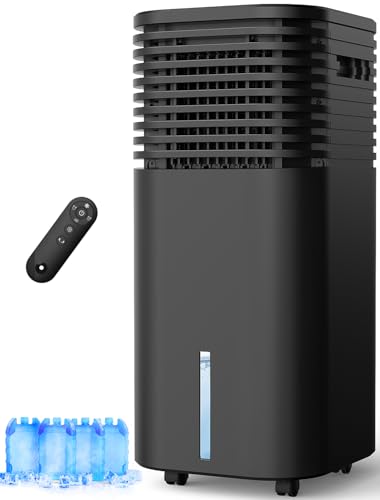
Portable evaporative coolers should navigate easily between living areas, home offices, and outdoor patios. Heavy duty multi-directional caster wheels and integrated ergonomic handles make shifting a full or empty unit painless across varied floorings. Slim tower designs maximize usable floor area in compact bedrooms, while wider horizontal units deliver higher airflow across open living rooms.
Automatic louvre oscillation expands the effective cooling zone by sweeping chilled air across an arc of eighty to one hundred twenty degrees. Wide angle distribution prevents continuous cold drafts from concentrating on a single spot, creating balanced ambient temperatures. Adjustable vertical vanes allow you to direct the primary breeze toward seating height or sleeping zones as needed.
When arranging your room layout, ensure the intake grilles have adequate clearance from walls and furniture to draw unobstructed fresh air. Maintaining proper hygiene in high traffic seating areas by learning how to clean and care for your stackable chair complements a clean, fresh airflow environment. Proper positioning guarantees maximum cooling coverage across every corner of your living quarters.
Smart Controls, Connectivity, and Maintenance Features
Modern evaporative coolers incorporate sophisticated electronic controls that elevate everyday user convenience. Digital LED touch panels provide clear visibility of fan speeds, timer settings, and active operating modes. Wireless remotes and Wi-Fi mobile application connectivity allow you to adjust temperature settings and oscillation from the comfort of your couch.
Advanced water management systems alert users with audible chimes or illuminated icons when the water tank approaches empty. Some premium units feature specialized ice compartments or pre-filled reusable ice packs that supercharge the initial cooling sensation. Removable water reservoirs and modular pump assemblies make seasonal cleanout swift and hassle free.
Routine maintenance prevents mineral accumulation from hard tap water, which can stiffen cooling pads over time. Utilizing distilled water or adding water conditioning additives preserves pad absorbency and keeps internal pump channels clear. Choosing a cooler with accessible, tool-free access panels saves substantial time during monthly filter and reservoir rinses.
Why You Should Trust Us
Our editorial process focuses on rigorous, data-driven analysis to help homeowners make confident climate control purchases. We thoroughly evaluate manufacturer engineering blueprints, verified technical specifications, and airflow performance metrics across diverse residential cooling categories. By assessing airflow volume, tank capacities, noise levels, and energy draw across various price tiers, we highlight models that deliver proven real world utility.
We do not accept sponsored product placements or prioritize specific manufacturers over genuine consumer value. Our product comparisons remain completely objective, transparent, and grounded in standard HVAC engineering principles. We continuously update our buying recommendations to reflect newly released models and advancements in evaporative cooling technology.
Final Thoughts
Choosing the ideal cooling appliance depends on your climate, room square footage, and desired level of smart automation. For expansive open spaces and heavy duty cooling demands, the Hessaire MC37M 3100CFM Evaporative Cooler delivers class-leading airflow with its robust three-panel intake design. It offers exceptional performance for workshops, garages, and large living quarters where massive air turnover is essential.
Homeowners seeking cutting-edge smart connectivity and sleek, wall-adjacent placement will appreciate the Portacool APEX 500 Wi-Fi Enabled. Its digital louvres, whisper quiet motor, and mobile app controls bring premium convenience to modern spaces. Meanwhile, those needing maximum runtime with minimal refills will benefit from the massive reservoir of the Swamp Cooler Air Conditioners.
If you need an ultra quiet, budget friendly solution for bedrooms or personal desk setups, the CENSTECH Windowless Air Conditioner and the DREO TurboCool Misting Fan 765S provide versatile multi-mode comfort on modest energy budgets. Whether outfitting an office or organizing meeting spaces with the best meeting room schedulers, pairing proper airflow with efficient technology keeps indoor environments comfortable throughout the hottest months.
FAQs
How do evaporative coolers differ from traditional air conditioners?
Evaporative coolers use the natural process of water evaporation to lower air temperatures rather than chemical refrigerants and energy intensive compressors. They draw warm outside air through water saturated pads and circulate humidified, cooled air throughout the room. Traditional air conditioners recirculate indoor air while removing humidity, consuming substantially more electricity in the process.
What makes Best Evaporative Coolers for Home effective in dry climates during 2026?
Evaporative coolers thrive in dry climates because low ambient humidity allows maximum water evaporation, resulting in significant temperature drops. The dry air readily absorbs moisture from the damp cooling media, quickly lowering the temperature of the passing airflow. In arid regions, this process also adds welcome moisture to dry indoor spaces, easing respiratory discomfort and parched skin.
Do I need to keep a window open when running an evaporative cooler?
Yes, keeping a window or door slightly open is essential for proper evaporative cooler operation. Because the cooler constantly adds moisture to the room, fresh air ventilation allows humid air to escape rather than saturating the indoor atmosphere. Without open ventilation, humidity will build up rapidly, causing the cooling effect to diminish completely.
How much electricity do evaporative coolers consume compared to AC units?
Evaporative coolers consume roughly seventy to ninety percent less electricity than standard refrigerated air conditioning units. Because they only power a fan motor and a small water pump, most residential models run on sixty to three hundred watts. This minimal electrical draw translates into substantial energy cost savings throughout peak summer cooling seasons.
How often should I clean the water tank and cooling pads?
You should drain and rinse the water reservoir every two to four weeks to prevent algae growth and mineral deposit accumulation. Cooling pads should be inspected and rinsed with clean water once a month during active summer use. End of season maintenance involves thoroughly drying the pads and draining the tank completely before storing the unit.
Can I use ice in my evaporative cooler to make the air colder?
Adding ice cubes or frozen ice packs directly into the water reservoir can lower the water temperature and provide an immediate blast of colder airflow. While ice provides a temporary boost in cooling intensity, the core cooling effect still relies primarily on ambient evaporation. Many modern coolers come with dedicated ice compartments or reusable freezer blocks specifically designed for this purpose.
How do I calculate the right CFM rating for my room size in 2026?
To calculate the ideal CFM rating, multiply your room’s square footage by the ceiling height to determine the total cubic feet, then divide that number by two. For example, a three hundred square foot room with eight foot ceilings equals twenty-four hundred cubic feet, which requires a cooler rated at twelve hundred CFM. This standard sizing formula ensures the unit can replace the room’s air volume every two minutes.
Why does my evaporative cooler smell musty, and how can I fix it?
A musty odor usually indicates stagnant water in the reservoir or mildew forming on damp cooling pads that have not dried properly. Draining the tank, wiping down the interior with a mild vinegar solution, and letting the pads dry completely will eliminate odors. Running the fan on dry mode for thirty minutes before shutting the unit down helps keep pads fresh and mildew free.
Can an evaporative cooler work effectively in high humidity areas?
Evaporative coolers lose most of their cooling efficiency when ambient relative humidity levels rise above sixty percent. When the surrounding air is already saturated with moisture, it cannot absorb additional evaporated water, resulting in little to no temperature drop. In humid regions, the cooler acts essentially as an oscillating fan and may make the room feel muggy.
What are the main benefits of choosing Best Evaporative Coolers for Home over standard fans?
Standard electric fans simply push existing room temperature air across your skin, creating a convective wind chill without actually lowering ambient room heat. Evaporative coolers actively cool the air by ten to fifteen degrees by pulling it through chilled, water-soaked media pads. This process provides actual thermodynamic cooling and raises humidity levels in dry, arid indoor spaces.