

Most “small” air purifiers on Amazon aren’t actually sized for a desk — they’re room purifiers wearing a smaller box, with coverage claims that only make sense if the unit is sitting in the middle of a bedroom, not six inches from your keyboard. A true desktop air purifier is a different animal: something compact enough to live on the corner of your desk permanently, quiet enough to run through a full workday without becoming background noise on a call, and built to clean the small pocket of air you actually breathe rather than an entire room. After comparing 10 desktop air purifiers currently listed on Amazon, the Levoit Core Mini-P Air Purifier stands out as the strongest all-around pick — it’s genuinely desk-sized, backed by tens of thousands of reviews, and priced like an accessory rather than an appliance. This guide walks through what separates a real desk-sized purifier from a shrunken room unit, what HEPA claims actually mean at this size, how much noise and power draw to expect, and which of the picks below fit specific desk setups best.




Top Picks at a Glance
- Best Overall: Levoit Core Mini-P Air Purifier – a genuinely desk-sized unit with a multi-stage filter that targets smoke, allergens, pet dander, odor, and dust, backed by tens of thousands of reviews.
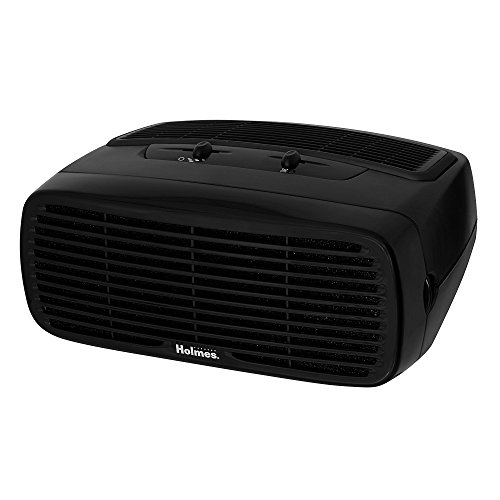
- Best Established Desktop Brand: Holmes Desktop HEPA-Type Air Purifier – a long-running desktop model from a recognizable small-appliance brand, with an optional ionizer setting.
- Best Budget: FULMINARE Portable Small Air Purifier – an affordable H13 True HEPA unit with a built-in night light, one of the highest review counts in this price range.
- Best Cordless: Pure Enrichment PureZone Mini Portable Air Purifier – a True HEPA unit explicitly built to clean the air “close to you” rather than a whole room, and it runs cordless.
- Best Ultra-Quiet: MEGAWISE Portable Air Purifier – a small tabletop unit with an H13 True HEPA filter rated at 24dB, quiet enough to sit inches from your ears.
- Best Smart/App-Controlled: GoveeLife Smart Mini Air Purifier – app and Alexa control plus multiple fan speeds, for anyone who wants scheduling and remote control on a desk unit.
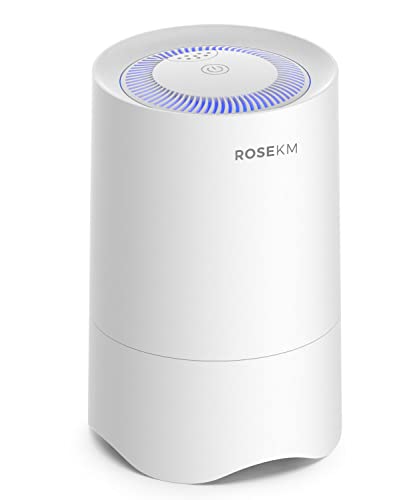
- Best for Tight Desk Space: Rosekm Personal Desk Mini Air Purifier – marketed specifically as a personal desk unit rather than a room purifier, at one of the lowest price points here.
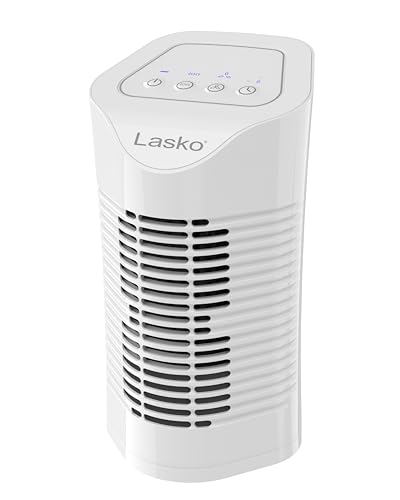
- Best Named-Brand Desktop Pick: Lasko HF11200 Desktop Air Purifier – a 3-stage filtration unit from an established home-appliance brand, sold specifically as a desktop model.
- Best 2-in-1 with Desk Fan: Crane 2-in-1 Air Purifier and Desk Fan – combines a small HEPA air purifier with a desk fan in one unit, built specifically for an office desk or nightstand.
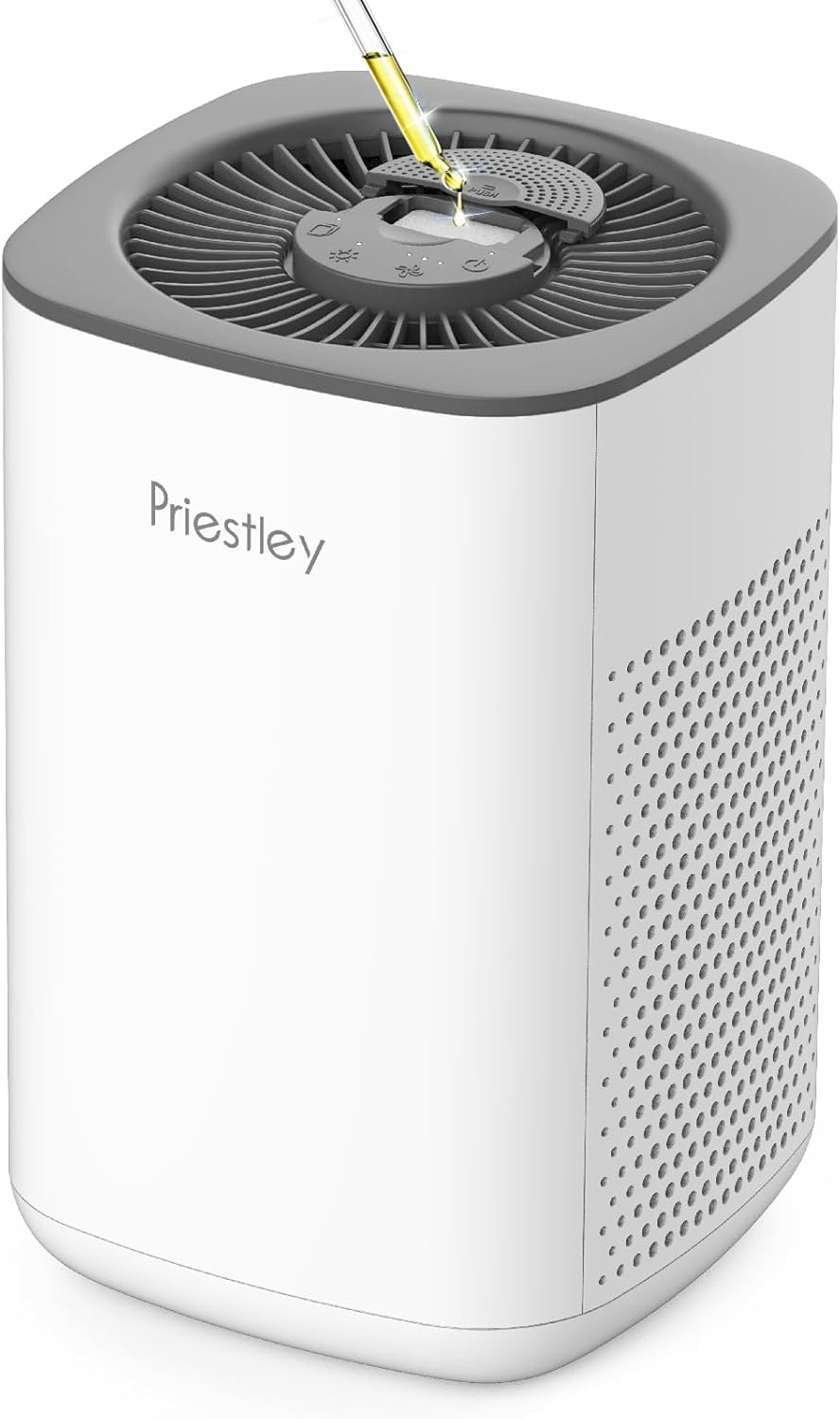
- Best with Aromatherapy: Priestley Small Air Purifier with Essential Oil Diffuser – a quiet 3-in-1 HEPA unit that doubles as an essential oil diffuser for anyone who wants scent along with filtration.
What Actually Counts as a Desktop Air Purifier?
The word “desktop” gets stretched loosely on Amazon, so it’s worth defining before comparing anything else. A real desktop air purifier is sized and positioned to sit directly on a desk, a monitor stand, or the shelf right beside your chair — it’s built around one person’s immediate breathing zone, not a room. That’s a different design goal from a room-sized purifier, which is built to move enough filtered air to cycle through hundreds or thousands of square feet over the course of an hour. Every pick above is small enough to sit on a desk without eating into your working surface, which is the baseline test this roundup applied before anything else.
This matters because a lot of listings blur the line on purpose. Several “compact” or “small room” units that show up in the same searches list coverage numbers in the hundreds or even low thousands of square feet — numbers that belong on a bedroom or open-floor purifier, not a device meant to sit next to a keyboard. If what you actually need is coverage for a private office or a larger open-plan area rather than just the desk itself, our best office air purifiers guide covers that fuller range, from personal units up through room-sized purifiers sized to square footage. This article stays narrowly focused on the smaller end of that range — the compact personal purifiers built for one person’s immediate space, not the whole room around them.
How Much Space Does a Desktop Air Purifier Really Cover?
Honestly, less than the box suggests. The realistic job of a desktop air purifier is to clean the volume of air within a few feet of your face over the course of continuous operation — not to noticeably change air quality across an entire room. That’s not a knock on the category; it’s the whole point of buying something this size instead of a console unit. If a listing for a desktop-sized device claims hundreds of square feet of coverage, read that number skeptically rather than as evidence the unit is somehow both compact and room-capable at once.
Where this category earns its keep is in situations a room unit can’t fully solve: a shared office where you don’t control the central air handling, a cubicle near a break room or printer, a dorm or small studio where a full-size purifier doesn’t fit, or simply wanting cleaner air right where you sit for eight hours a day regardless of what’s happening in the rest of the room. Sizing your expectations to “the air around me” rather than “the whole room” is the single biggest factor in being satisfied with a compact unit once it arrives.
True HEPA vs. “HEPA-Type” Filters on Mini Units
Filter quality is where the picks in this roundup split most clearly, and the label language matters more than most buyers expect even at this small scale. “True HEPA” (sometimes listed with an H13 rating) is a specific filtration standard, capturing 99.97% of particles down to 0.3 microns — that’s the claim behind the FULMINARE Portable Small Air Purifier, the Pure Enrichment PureZone Mini Portable Air Purifier, and the MEGAWISE Portable Air Purifier above, all of which list H13 True HEPA media explicitly in their listings.
“HEPA-type” or “HEPA-like” filtration, on the other hand, describes a filter built along similar lines without meeting the certified HEPA standard — the Holmes Desktop HEPA-Type Air Purifier is upfront about using this category rather than claiming True HEPA outright. That’s not automatically disqualifying for everyday dust and general particles, but if fine particulate, wildfire smoke, or allergy symptoms are the reason you’re buying, a True HEPA-rated unit is the safer bet, and it’s worth checking that distinction on the listing before assuming every “HEPA” mention means the same thing.
CADR and Filtration at Desk Distance
CADR (Clean Air Delivery Rate) measures how much filtered air a purifier moves per minute, and it’s the number most room-purifier shopping guides tell you to prioritize. On a desktop air purifier, CADR matters less than filter quality and placement, simply because the unit is already sitting a foot or two from your face rather than trying to circulate air across a whole room. A unit with a modest CADR number but a True HEPA filter positioned close to you will often do more for the air you actually breathe than a higher-CADR unit that’s too big to sit within arm’s reach and ends up on the floor across the room instead.
That said, CADR isn’t meaningless here — it’s still a rough proxy for airflow, and a unit that barely moves any air won’t do much even at close range. Use it as a tiebreaker between similarly filtered options rather than the primary factor, and don’t assume a bigger CADR number on a desktop-class unit automatically means better real-world performance at your desk.
Noise Levels — Why dB Matters More on a Desk Than in a Living Room
A purifier’s decibel rating means something different depending on distance. A 45dB room purifier across a bedroom is barely noticeable; the same 45dB output a foot from your ears during a video call is genuinely distracting. That’s why noise level deserves more weight when shopping for a desktop air purifier than it would for a room-sized unit — you’re going to be sitting right next to it for hours at a time.
The MEGAWISE Portable Air Purifier lists a 24dB rating on its low setting, among the quietest options in this roundup and a reasonable benchmark for “won’t interrupt a call.” The Priestley Small Air Purifier with Essential Oil Diffuser lists a similar 20dB quiet mode. If a listing doesn’t specify a dB rating at all, treat that as a gap worth investigating in the reviews before buying, since noise complaints are one of the most common things people mention after living with one for a few weeks.
Power Options — USB, Battery, and Plug-In Desktop Air Purifiers
How a desktop air purifier gets power affects how well it actually fits a desk setup. Some, like the Pure Enrichment PureZone Mini Portable Air Purifier, run cordless on an internal battery, which is convenient for moving the unit between a desk and a bag but means it eventually needs recharging rather than running continuously. Others plug directly into a wall outlet, which sacrifices some portability but keeps the unit running indefinitely without you thinking about it — a real advantage if you want something that’s simply always on.
A USB-powered desktop air purifier splits the difference: it can draw power from a laptop, a monitor’s USB hub, or a small power adapter, which keeps cable clutter down on an already-crowded desk but means the unit stops running whenever the device it’s plugged into is off or asleep. None of that makes one power format objectively better — it’s a question of whether you want a unit that runs whenever you’re at your desk, or one that runs continuously regardless of what else is powered on around it.
Extra Features Worth Paying For (and Ones That Aren’t)
A handful of extras show up repeatedly across this category, and it’s worth being clear-eyed about which ones actually add value. Smart app and voice control, like on the GoveeLife Smart Mini Air Purifier, is genuinely useful if you want to schedule the unit or check its status without walking over to it — a real convenience feature rather than a gimmick. A built-in fan, like on the Crane 2-in-1 Air Purifier and Desk Fan, is also a legitimate dual-purpose upgrade for anyone who already wanted a small desk fan and can combine both into one footprint; our best office fans guide covers dedicated desk fan options if airflow matters more to you than filtration.
Night lights and aromatherapy/essential oil pads, on the other hand — features found on the FULMINARE Portable Small Air Purifier and the Priestley Small Air Purifier with Essential Oil Diffuser — are pleasant additions but don’t improve filtration performance at all. They’re fine reasons to prefer one pick over another when filter quality and noise are otherwise comparable, but they shouldn’t be the deciding factor if clean air, not ambiance, is the actual goal.
How We Evaluated These Picks
These recommendations come from a review of publicly available Amazon listing data — stated filter type (True HEPA vs. HEPA-type), decibel ratings where listed, power source, physical size and desktop-specific marketing language, price, and customer review volume — across desktop and personal air purifier listings on Amazon. We deliberately excluded units marketed primarily around large coverage numbers for bedrooms, open floors, or private offices, since those belong to a different, room-scale category rather than a genuine desktop air purifier, and we cross-checked every product name and ASIN against the source Amazon listing before including it here. This is a specification and listing-data comparison rather than a hands-on noise or filtration test, so treat dB ratings and filter claims as a starting point, and confirm current pricing, color options, and filter replacement availability on the product page itself before buying.
Common Mistakes to Avoid
The most common mistake is buying a “small” or “compact” purifier that’s actually a shrunken room unit and expecting it to behave like a true desktop air purifier — checking the physical dimensions and intended placement, not just the word “small” in the title, avoids this. A close second is assuming any listing that mentions “HEPA” is using a certified True HEPA filter; several units in this category are explicit about using HEPA-type or HEPA-like media instead, which filters differently.
Buyers also frequently ignore the dB rating, or the lack of one, and end up with a unit that’s noticeably distracting a foot from their ears during calls. Another frequent error is picking a unit based on coverage square footage rather than filter quality and noise — at desk distance, a well-filtered, quiet unit beats a higher-coverage one that’s too loud or too big to actually sit close to you. Finally, some buyers overlook filter replacement cost and availability on the lowest-priced units, only to find replacements are hard to source or nearly as expensive as buying a new unit outright.
Desktop Air Purifier Buying Checklist
- Confirm the unit is genuinely desk-sized and marketed for personal or desktop placement, not a shrunken room purifier with an inflated coverage number.
- Check whether the filter is labeled True HEPA/H13 or HEPA-type/HEPA-like, and weigh that against how sensitive you are to fine particulate or allergens.
- Look for a stated dB rating; anything in the low-to-mid 20s is close to silent at desk distance, while ratings in the 40s and above may be noticeable during calls.
- Decide whether you want USB power, battery/cordless, or a wall-plug unit based on how you want the unit to fit into your desk setup.
- Treat CADR and coverage square footage as secondary to filter quality and placement for anything sized to sit on a desk.
- Factor in filter replacement cost and availability before settling on the lowest-priced option on the list.
- Treat night lights, aromatherapy pads, and built-in fans as tiebreakers, not primary decision factors.
- If you actually need to cover a whole room or private office rather than just your desk, size up to a room-rated purifier instead of a desktop unit.
If your real need is cleaning an entire room or private office rather than just the air around your desk, our best office air purifiers guide covers that fuller range of units sized to square footage. Curious whether your space actually has an air quality problem worth solving before buying anything? Our best office air quality monitors guide can help you check CO2, VOCs, and particulate levels first. And if the discomfort you’re trying to fix is dry air rather than dust or smoke, our best office humidifiers guide addresses that different problem directly.
FAQ
What’s the difference between a desktop air purifier and a regular air purifier?
It’s sized and positioned to sit directly on or beside a desk, cleaning the air in one person’s immediate breathing zone. A regular or room-sized air purifier is built to circulate and filter air across an entire room or office, with coverage rated in square footage rather than “the space around one chair.”
Will a desktop air purifier clean my whole room?
Not meaningfully. It’s designed to clean the air close to where it sits, not to cycle enough air through an entire room to noticeably change room-wide air quality. If whole-room coverage is the goal, a room-sized purifier sized to your square footage is the better fit — see our best office air purifiers guide for that range.
Is “HEPA-type” the same as True HEPA on a desktop air purifier?
No. True HEPA (often H13-rated) is a certified standard capturing 99.97% of particles at 0.3 microns. “HEPA-type” or “HEPA-like” describes a filter built similarly but not certified to that standard, and it generally filters less effectively at the smallest particle sizes. Check the specific wording on the listing rather than assuming every “HEPA” mention is equivalent.
Can a desktop air purifier run off a USB port?
Several can. USB-powered units draw power from a laptop, monitor hub, or small adapter, which keeps cable clutter down but means it only runs while the power source is on. Others run on an internal battery for full cordless use, and some are standard wall-plug units for continuous, always-on operation.
Are desktop air purifiers loud enough to be distracting during work?
It depends on the unit and the dB rating, and this matters more here than with a room purifier because it sits so close to you. Units rated in the low-to-mid 20s dB are close to silent at arm’s length, while units without a stated dB rating or with ratings in the 40s and above are worth checking in customer reviews before assuming they’ll stay unnoticeable during calls.
How often do desktop air purifier filters need to be replaced?
It varies by model and usage, and it’s not always clearly stated on cheaper listings. Before buying, check whether replacement filters are sold separately and how often the manufacturer recommends swapping them — on some budget units, filters are inexpensive and easy to find, while on others replacements can be harder to source than the unit itself is worth.


