A laptop docking hub is the small box that turns “unplug three cables and pack up” into “unplug one cable and go.” Instead of connecting a monitor, an Ethernet line, a mouse, and a charger separately every morning, you plug a single USB-C or Thunderbolt cable into your laptop and the docking hub handles the rest — external displays, wired network, USB ports, an SD card slot, and often laptop charging in the same connection. That’s a different job from a desk charging dock, which exists to top off a phone, a smartwatch, or a pair of earbuds; if that’s what you need, our guide to desk charging docks covers that instead. This guide focuses on hubs built to extend a laptop’s ports, drive multiple monitors, and simplify a “dock once, unplug once” setup, using real listings pulled from Amazon so every recommendation is grounded in an actual product, not a guess.





Top Picks at a Glance
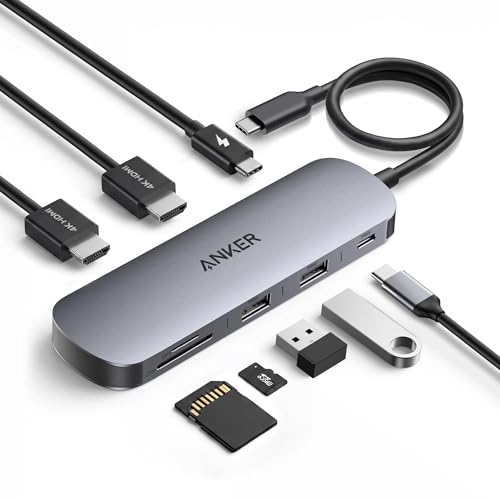
- Best Overall: Anker Laptop Docking Station Dual Monitor, 8-in-1 USB C Hub with 4K HDMI — a well-reviewed dual-monitor docking hub with Ethernet, an SD/TF reader, and 85W pass-through charging in one compact unit.
- Best Premium: Anker Prime Docking Station, 14-in-1 Laptop Docking Station Dual Monitor — a high-output dock built for demanding setups, with dual 4K HDMI, fast 10Gbps data transfer, and 160W of total power.
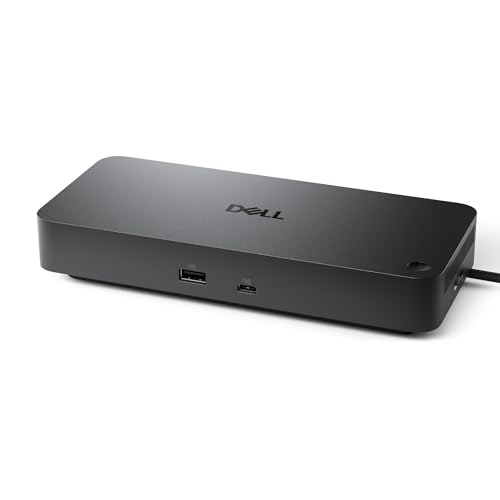
- Best for Dell and Business Laptops: Dell Pro Laptop Docking Station WD25, USB-C, 100W, DisplayPort, HDMI — a quad-display-capable dock designed around Dell’s enterprise laptop lineup and office deployments.
- Best for Triple Monitor Setups: Acer Laptop Docking Station 3 Monitors, 11-in-1 USB C Docking Station — an 11-port hub that can push video to three separate displays, including one at 8K resolution.
- Best Budget: Anker Nano Laptop Docking Station Dual Monitor, 8-in-1 USB C Hub for Windows — an affordable entry point that still covers dual 4K@60Hz output and 85W charging.
- Best for High-Resolution Output: UGREEN USB C Docking Station Dual Monitor, 10-in-1 Laptop Dock with 2 HDMI — supports a single 8K display alongside dual HDMI, Ethernet, and multiple 5Gbps data ports.
- Best for Legacy USB-A Laptops: Plugable Universal Laptop Docking Station Dual HDMI Monitor for Windows and Mac — a driver-based dock that works over USB 3.0 or USB-C, useful for older machines without a full-featured USB-C port.
- Best for Maximum Port Count: RayCue 15-in-1 Laptop Docking Station 3 Monitors, Triple 8K Display — a heavily-loaded hub with three HDMI outputs, six USB ports, and Gigabit Ethernet.
- Best for Mac and Windows Compatibility: MOKiN Laptop Docking Station Dual Monitor 4K HDMI USB C Hub for Dell/HP/Mac — a 14-in-1 dock listed as compatible with both MacBook and major Windows laptop brands.
What a Laptop Docking Hub Actually Does
The whole point of a laptop docking hub is consolidation. Instead of running separate cables to a monitor, a network switch, a keyboard, and a charger, you plug in one cable and every peripheral connected to the hub wakes up at once. Unplug that same cable at the end of the day and the laptop is instantly free to travel — no hunting for four different cords tangled behind a monitor stand. That single interaction is usually described as “dock once, unplug once,” and it’s the main reason people upgrade from a bare laptop setup to a dedicated docking hub in the first place.
It’s worth separating a full docking station from a basic USB-C hub, since Amazon listings often blur the line. A simple hub might add two or three USB ports and a single HDMI output — useful, but limited. A true dock goes further: Ethernet for wired networking, an SD or microSD card slot, several USB-A and USB-C data ports, and enough Power Delivery to charge the laptop itself while it’s connected. If a listing only mentions one video output and no Ethernet port, it’s closer to a basic hub than a full dock, even if the word “dock” appears in the title.
One more distinction matters here: a laptop docking hub is not a charging accessory for phones or wearables. If your goal is a spot to charge a phone, an Apple Watch, and a pair of AirPods overnight, a docking hub is the wrong purchase — that’s what a desk charging dock is built for, with wireless Qi/MagSafe pads and multi-port phone chargers instead of monitor outputs. This guide is strictly about hubs that extend a laptop’s ports for a desk workstation, not devices that top off a smartphone battery.
How Many Monitors Can a Laptop Docking Hub Actually Drive?
This is where a lot of buyers get surprised after the purchase. A docking hub might be labeled “dual monitor” or “triple monitor,” but whether your laptop can actually push video to that many external displays depends on a feature called Multi-Stream Transport, or MST. MST lets a single USB-C or Thunderbolt connection carry multiple independent video signals at once, but not every laptop’s graphics chip and USB-C controller support it. Two laptops with the exact same port can behave completely differently — one drives two external monitors without issue, the other only manages one, no matter how many HDMI ports the dock itself has.
Before buying one specifically for a two- or three-monitor setup, check your laptop’s own specifications for MST support, sometimes listed under “multiple display” or “external display” support in the manufacturer’s documentation. If MST isn’t supported, a docking hub with three HDMI ports will still typically only mirror or extend to a single external screen. This single detail causes more return requests than any other issue with this category of dock, so it’s worth five minutes of research before ordering.
Resolution matters too. A docking hub advertising “8K” support usually means one external display can run at that resolution, while additional displays drop to 4K or lower — the total video bandwidth of the connection has to be shared across every monitor plugged in. If your work genuinely needs three 4K screens running simultaneously at full resolution and refresh rate, look specifically for a docking hub built around Thunderbolt rather than standard USB-C, since Thunderbolt generally offers more bandwidth headroom for that kind of load.
USB-C vs Thunderbolt Docking Hubs: Which Standard Matters
Most laptop docking hubs on the market use standard USB-C with DisplayPort Alt Mode, which routes video signal through the same physical connector used for charging and data. This works well for most desk setups — a single external monitor at 4K, or two monitors at more modest resolutions, along with Ethernet, USB ports, and laptop charging. It’s also the more affordable route, and the majority of docking hubs built for Dell, HP, Lenovo, and similar business laptops fall into this category.
Thunderbolt 3 and Thunderbolt 4 docking hubs cost more but carry substantially more bandwidth over the same physical cable type. That extra headroom is what makes driving two or three high-resolution monitors at full refresh rate more reliable, and it’s also why creative professionals working with large video or photo files often prefer a Thunderbolt dock — file transfer speeds benefit from the higher bandwidth as much as the displays do. If your laptop only has standard USB-C ports without Thunderbolt support, a Thunderbolt-branded dock won’t unlock extra performance; the laptop’s own port has to support the standard for it to matter.
One more wrinkle worth checking before buying: some older or specialized docking hubs, like the Plugable UD-3900 model, use a driver-based connection rather than a purely native USB-C or Thunderbolt link, and require installing manufacturer software for the display outputs to work correctly. That approach still gets the job done, particularly for older laptops without a full-featured USB-C port, but it’s a different setup process than the plug-and-play experience most newer docks offer.
Power Delivery: Can Your Dock Charge the Laptop Too?
Pass-through charging is one of the most useful features on a modern docking setup, and also one of the most misunderstood. The idea is simple: plug the power adapter into the dock instead of the laptop, and the dock forwards enough power through the same cable to charge the laptop while it also handles video, Ethernet, and USB traffic. In practice, whether that actually charges your laptop at a normal rate depends entirely on the wattage the dock delivers compared to what your laptop needs.
Docks in this space typically advertise Power Delivery output somewhere between 65W and 100W, with premium models pushing 160W or higher. A thin ultrabook that ships with a 45-65W charger will charge just fine on almost any dock with Power Delivery support. A larger workstation laptop or a gaming laptop that came with a 130W or 180W charger, on the other hand, may only trickle-charge — or not charge at all under heavy load — on a dock rated well below that number. Before buying a docking hub specifically to replace your laptop charger, check the wattage printed on your original power adapter and compare it against the dock’s rated PD output.
It’s also worth noting that total dock wattage and per-port charging wattage aren’t always the same number. A docking hub rated at “100W” is describing the maximum it can deliver to the laptop through the upstream connection, not power available at every other port simultaneously. Read the specifics in the listing rather than assuming the headline wattage tells the whole story.
Ethernet, SD Card Slots, and Other Ports That Matter for a Desk Setup
A built-in Ethernet port is one of the clearest signs a product is a genuine laptop docking hub rather than a stripped-down USB-C adapter. Wired networking avoids the latency and occasional drop-outs of Wi-Fi, which matters more than it sounds for video calls, large file transfers, or anything sensitive to a stable connection. Most full-featured docks include a Gigabit Ethernet port as standard, and it’s a feature worth prioritizing if your home or office network is inconsistent.
An SD or microSD card slot is another detail that separates hubs built for real desk work from bare-bones adapters. Photographers, video editors, and anyone regularly pulling files off a camera benefit from a dedicated card reader built into the docking hub instead of needing a separate USB card reader cluttering the desk further. Not every model includes one, so check the port list carefully if this matters to your workflow.
Beyond video and networking, the remaining USB-A and USB-C ports on a docking hub are what actually keep a desk usable day to day — a wired mouse, a mechanical keyboard, an external hard drive, and a webcam can each claim a port without needing to unplug something else first. A hub with only two or three extra ports fills up fast; if your desk setup includes several peripherals, look for a model in the 10-to-15-port range rather than a compact 6-in-1 hub.
Mac vs Windows Compatibility: What to Check Before You Buy
Compatibility between a laptop docking hub and MacBooks deserves its own check before ordering. Apple Silicon MacBooks (M1 through the newer M-series chips) have historically limited the number of external displays a single USB-C or Thunderbolt port can drive natively, and MST support on macOS has been inconsistent across generations — a docking hub that flawlessly runs three monitors on a Windows laptop might only manage one external display on certain MacBook models, regardless of how many HDMI ports the dock has.
Several docking hubs in this space explicitly list MacBook compatibility alongside Dell, HP, and Lenovo support, which is worth looking for if you split time between platforms or work in a mixed-device office. Even then, it’s worth checking the specific MacBook generation against the manufacturer’s compatibility notes, since Apple’s own display limitations sometimes override what the dock itself is capable of.
Windows laptops generally have fewer restrictions here, with most modern business and consumer laptops supporting MST-based multi-monitor output through a compatible docking hub without additional configuration. If your setup is Windows-only, this is less of a concern — just confirm your specific laptop model supports the number of external displays you’re planning to run.
How We Evaluated These Picks
Every product in this guide was pulled from live Amazon listings and cross-checked against the actual title, price, and customer review data at the time of research, rather than assumed from a spec sheet or brand reputation alone. We prioritized docking hubs that clearly listed video output specifics (number of ports, resolution, and refresh rate), confirmed Power Delivery wattage for laptop charging, and included Ethernet or an SD card slot where advertised. We also weighed review volume as a signal of real-world reliability, favoring models with a meaningful number of verified purchases over newer listings with limited feedback. Compatibility claims for Windows and Mac were taken directly from the listing details rather than inferred.
Common Mistakes to Avoid
The most common mistake is buying a dock advertised for dual or triple monitors without first confirming the laptop itself supports MST — the hub can only drive as many independent displays as the laptop’s graphics and USB-C controller allow. Another frequent misstep is assuming a “100W” docking hub will fast-charge any laptop, when that number often only applies under specific conditions and may fall well short of what a power-hungry workstation or gaming laptop actually needs to charge normally.
Buyers also sometimes confuse a laptop docking hub with a phone charging accessory, expecting wireless charging pads or Apple Watch support that a monitor-and-Ethernet-focused dock was never designed to provide — if that’s the actual need, a dedicated desk charging dock is the better purchase. Skipping the Mac compatibility check is another common pitfall for anyone splitting time between a MacBook and a Windows machine, since display limitations can differ significantly between the two platforms even on the same dock. Finally, some shoppers pick the hub with the most total ports without checking whether the ones that matter most to them — Ethernet, SD card, or a specific video output — are actually included.
Buying Checklist
- Confirm your laptop supports MST before buying a dual- or triple-monitor docking hub.
- Match the dock’s Power Delivery wattage to your laptop’s original charger rating, not just the headline number.
- Check for a built-in Ethernet port if a stable wired connection matters for your work.
- Look for an SD or microSD card slot if you regularly transfer files from a camera.
- Count how many USB-A and USB-C ports you need for a mouse, keyboard, and external drives.
- Verify Mac compatibility separately from Windows compatibility if you use a MacBook.
- Decide between standard USB-C and Thunderbolt based on your bandwidth needs and budget.
- Check whether the dock requires driver installation or works as true plug-and-play.
FAQ
What’s the difference between a laptop docking hub and a regular USB-C hub?
A basic USB-C hub usually adds a couple of USB ports and one video output. A full dock goes further, typically including Ethernet, an SD card slot, multiple video outputs capable of dual or triple monitors, and enough Power Delivery to charge the laptop while it’s connected.
Can a docking hub charge my laptop while it’s plugged in?
Many can, through pass-through Power Delivery charging, but only if the dock’s rated wattage meets or exceeds what your laptop’s original charger provides. A 65-100W dock suits most ultrabooks; larger workstation or gaming laptops may need a higher-wattage dock rated 130W or above.
Why does my docking hub support three monitors but my laptop only shows two?
This almost always comes down to Multi-Stream Transport (MST) support on the laptop itself, not the dock. If your laptop’s graphics chip and USB-C controller don’t support MST, it will cap the number of independent external displays no matter how many video ports the docking hub has.
Is a Thunderbolt docking hub worth it over a standard USB-C model?
It depends on your workload. Thunderbolt docks offer more bandwidth, which helps with driving multiple high-resolution monitors at full refresh rate or transferring large files quickly. For a single external monitor or basic dual-display setup, a standard USB-C docking hub is usually sufficient and more affordable.
Will a docking hub work with both a MacBook and a Windows laptop?
Some are listed as compatible with both, but display behavior can differ — Apple Silicon MacBooks have historically had more restrictive external display limits than comparable Windows laptops. Check the specific MacBook generation against the dock’s compatibility notes before assuming full functionality.
Do I need a docking hub if I only use one external monitor?
Not necessarily. If you only need one display, Ethernet, and a couple of extra ports, a simpler and less expensive USB-C hub may cover your needs. A full docking hub earns its price when you’re running multiple monitors, need wired networking, or want single-cable laptop charging built in.
A laptop docking hub is really a desk-organization decision as much as it’s a hardware purchase — the right one turns a cluttered set of cables into a single connection you plug in each morning and unplug each night. Once your monitor and port setup is sorted, a few complementary pieces round out the workstation: a monitor stand riser to get your display to eye level, a desk built for multi-monitor setups if you’re outgrowing your current surface, or a cable box to hide the remaining cords your dock doesn’t tuck away on its own. Among the 9 options covered here, the right laptop docking hub in 2026 ultimately comes down to how many monitors you run, how much charging power your laptop needs, and whether your daily setup is Windows, Mac, or both.